
Key takeaways
- A 2017 review found 18 reported cases where biotin helped hair or nails, and every one involved an underlying condition. Evidence in healthy people is lacking.
- The NHS lists stress, illness, weight loss, iron deficiency and pattern hair loss among the usual causes. Rule those out with your GP first.
- From 150 µg a day, biotin can distort lab tests, including thyroid tests and troponin, a heart-attack marker (BfR, 2026). Hair products contain up to 80 times that.
- The NHS says 0.9 mg (900 µg) or less a day of biotin from supplements is unlikely to cause harm. Many hair products give 10–12 mg, more than ten times that.
- The authorised claim (UK and EU), maintenance of normal hair, applies from 7.5 µg a day. No authorised claim says biotin makes hair grow or stops hair loss.
The short answer
Biotin helps hair if you are short of biotin, and that is rare: according to the US National Institutes of Health, severe deficiency has never been reported in healthy people eating a normal diet. If your hair is thinning, the useful first step is finding out why, not buying a 10,000 µg tablet. And if you do take biotin, tell your doctor before any blood test.
What the evidence shows
A 2017 review in Skin Appendage Disorders went through the published research on biotin for hair and nails. It found 18 reported cases in which biotin helped. All of them had an underlying condition affecting hair or nail growth. The authors concluded that there is limited research to support biotin in healthy people.
There are no good-quality trials showing that high-dose biotin thickens hair or slows hair loss in people with normal biotin levels. And because many types of hair loss are temporary, before-and-after stories can’t show whether biotin made the difference.
Rule out the usual causes first
The NHS notes that losing 50 to 100 hairs a day is normal. It separates hair loss into:
- Permanent, such as male and female pattern hair loss, which often runs in families.
- Temporary, caused by things like illness, stress, cancer treatment, weight loss and iron deficiency.
The NHS advises seeing a GP if you are worried, and before paying for a commercial hair clinic. Sudden, patchy or heavy hair loss needs a doctor rather than a supplement. Low iron is one of the causes a simple blood test can find: see iron and tiredness for which test to ask for.
The blood-test problem
Many lab tests use a biotin–streptavidin reaction to measure hormones and other markers. Biotin in your blood can interfere with it. Germany’s Federal Institute for Risk Assessment (BfR) updated its warning in May 2026:
- Problems were seen mostly from 150 µg of biotin a day.
- Thyroid tests can show falsely high T3 and T4 and falsely low TSH, which can look like an overactive thyroid.
- Troponin, used to diagnose heart attacks, can be falsely low. The US FDA has warned clinicians about this more than once.
The BfR advises telling your doctor or lab staff about current or recently stopped biotin. In the UK, the makers of levothyroxine (a thyroid medicine), in agreement with the MHRA, have warned doctors about the same problem with thyroid tests. The lab can tell you whether your test is affected.
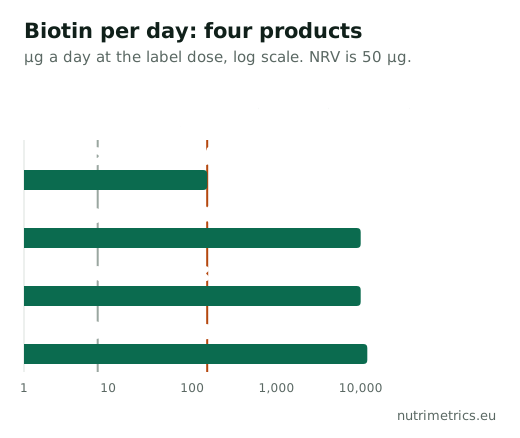
| Product (our database, Spain and Germany) | Biotin a day | Compared with the 150 µg test-problem level | Compared with the NHS 900 µg figure |
|---|---|---|---|
| Vitamaze Biotin 10.000 µg + Zink + Selen | 10,000 µg | About 67 times | About 11 times |
| NatuGena Biotin, Zink & Selen | 10,000 µg | About 67 times | About 11 times |
| Aldous Biotina Complex | 12,000 µg | 80 times | About 13 times |
| Aldous Colágeno + Ácido Hialurónico | 150 µg | At the level | Below |
If you still want to try biotin
- A modest dose is enough for the legal claim. The authorised claim that biotin contributes to the maintenance of normal hair and skin applies from 7.5 µg a day. A higher dose doesn’t earn a stronger claim.
- Stay near the NHS figure. If you take biotin anyway, a product with 900 µg or less a day stays within what the NHS considers unlikely to cause harm.
- Check the zinc in combinations. The NHS says not to take more than 25 mg of zinc a day from supplements; Germany’s BfR recommends no more than 6.5 mg per daily dose. The Vitamaze and NatuGena tablets give 10 mg; Aldous Biotina Complex gives 15 mg.
- Check the extras. Aldous Biotina Complex also contains 50 µg of vitamin D: half the NHS daily maximum and well above the BfR’s recommended 20 µg per daily dose. Count it if you already take vitamin D.
- Give it a time limit. If nothing has changed after three to six months, stop paying for it.
What the label may claim
Biotin may claim that it contributes to the maintenance of normal hair, skin and mucous membranes, normal energy-yielding and macronutrient metabolism, and normal nervous system and psychological function. Zinc and selenium may claim maintenance of normal hair and nails. No authorised claim says any of them makes hair grow, thickens it or stops hair loss. If a product says so, it is using a claim that is not authorised in the UK or the EU.
Compare every biotin product we have checked, with doses and flags, on our biotin page. Our guide to approved health claims explains what labels may legally say.
FAQ
Does biotin help hair loss?
Only if you are short of biotin, which is rare. A 2017 review found that all reported cases where biotin helped involved an underlying condition, and concluded there is limited research to support it in healthy people.
How much biotin is in hair supplements?
Usually 5,000 to 12,000 µg a day. The reference intake on UK and EU labels (NRV) is 50 µg, which most people get from food. The NHS says 900 µg or less a day from supplements is unlikely to cause harm.
Should I stop biotin before a blood test?
Tell your GP, nurse or the lab that you take biotin, or stopped recently. Germany's BfR reports test problems mostly from 150 µg a day, and the lab can tell you whether your test is affected and how long to pause.
What should I check if my hair is falling out?
See your GP, especially if it is sudden, patchy or heavy. Common temporary causes include illness, stress, weight loss and iron deficiency, which a ferritin test can show.
Are biotin, zinc and selenium combinations better?
Zinc and selenium also have authorised claims for normal hair or nails, but there is no good evidence the combination regrows hair. Check the zinc dose: the NHS says not to take more than 25 mg a day from supplements, and Germany's BfR recommends no more than 6.5 mg per daily dose.
Sources
- NHS — B vitamins and folic acid
- MHRA/EMA — Levothyroxine: biotin interference with laboratory tests (healthcare professional letter)
- NHS — Others (magnesium, selenium, zinc)
- DHSC — Great Britain nutrition and health claims (NHC) register
- Patel DP, Swink SM, Castelo-Soccio L. A review of the use of biotin for hair loss. Skin Appendage Disord, 2017
- BfR — Biotin supplements can distort laboratory tests (FAQ, May 2026, German)
- TCTMD — FDA reminds clinicians about biotin interference with troponin tests
- NHS — Hair loss
- NIH Office of Dietary Supplements — Biotin fact sheet for health professionals
- BfR — Proposed maximum levels for zinc in food supplements
- European Commission — EU Register of nutrition and health claims