
Key takeaways
- In Great Britain a health claim is legal only if it is listed in the GB nutrition and health claims register, uses the authorised wording and the product contains the minimum amount set for that claim. Northern Ireland and the EU use the EU register.
- The GB register started as a copy of the EU register on 1 January 2021, so every claim in this table applies in both. Since then GB has only rejected new claims, including creatine for brain function (2024).
- For vitamins and minerals, the minimum is usually 15% of the nutrient reference value (NRV) per daily dose — for example 56 mg of magnesium or 0.75 µg of vitamin D.
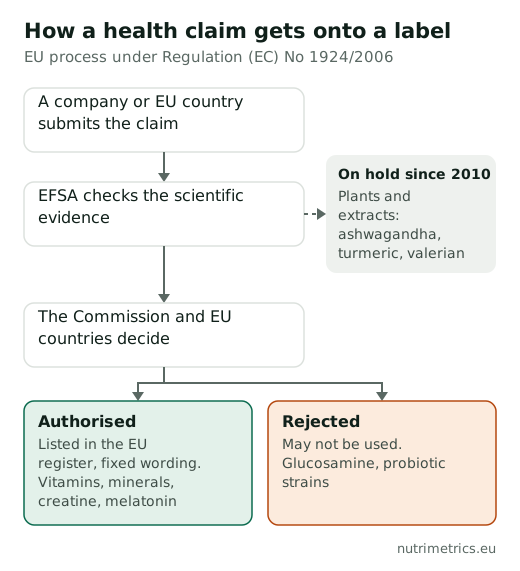
- Botanicals such as ashwagandha, turmeric, valerian and rhodiola have no authorised claims: their claims have been "on hold" for years.
- Glucosamine for joints, probiotics for digestion and collagen for skin have no authorised claims. Labels often work around this by adding vitamin C or another nutrient that does. In the UK, even the word "probiotic" counts as a health claim.
The short answer
Most supplement packs in the UK and the EU can only say a small number of things, and only in set words. Vitamins and minerals have dozens of authorised claims. A few other ingredients — omega-3 DHA and EPA, creatine, melatonin, glucomannan — have one or two each. Plants and extracts (ashwagandha, turmeric, valerian, rhodiola, milk thistle) have none, and nor do glucosamine, probiotics or collagen on their own.
When a pack promises more than the claims in the table below, it is going beyond what the law allows.
UK and EU: one table, two registers
- Great Britain (England, Scotland, Wales) uses the GB nutrition and health claims register, kept by the Department of Health and Social Care. New applications are assessed by the UK Nutrition and Health Claims Committee (UKNHCC) instead of EFSA.
- Northern Ireland still uses the EU register, because EU food law applies there under the Windsor Framework.
- The content is the same for everything in this guide. The GB register was copied from the EU register on 1 January 2021. The decisions GB has taken on its own since then are all rejections or narrow changes: a lutein and zeaxanthin combination, a change to a beta-glucan claim, creatine and cognitive function (rejected in 2024 because the evidence for 3 g a day did not show an effect) and green kiwifruit powder (2026). The European Commission has also moved to reject the same creatine claim (draft regulation notified to the WTO in 2025).
- Adverts too. In the UK, the Advertising Standards Authority applies the same register to ads and websites (CAP Code section 15).
- What may change: under the UK-EU SPS agreement being negotiated for mid-2027, Great Britain would align with EU rules on claims and food supplements again.
How the rules work
- The register is the list. Regulation (EC) No 1924/2006, kept in UK law after Brexit, says a health claim may only be used if it is authorised and listed in the register. Most general claims are in Regulation (EU) No 432/2012.
- The wording is fixed. Brands may adapt the phrasing slightly for consumers, but the meaning must stay the same. “Contributes to the reduction of tiredness and fatigue” cannot become “beats fatigue”.
- There is a minimum dose. For vitamins and minerals, the product must be at least a “source” of the nutrient: 15% of the nutrient reference value per daily dose. Other ingredients have their own conditions (3 g of creatine, 1 mg of melatonin, 250 mg of DHA).
- No disease claims. A supplement may not claim to prevent, treat or cure a disease. In the UK, a product presented that way is treated as a medicine by the MHRA.
The table: what each ingredient may claim
Claims are summarised; the exact wording is in the register. Minimum = amount per recommended daily dose needed to use the claims.
| Ingredient | May claim that it contributes to… | Minimum per daily dose | Common claims that are not authorised |
|---|---|---|---|
| Magnesium | Reduction of tiredness and fatigue; normal muscle function; nervous system; psychological function; energy metabolism; bones and teeth; electrolyte balance | 56 mg (15% of 375 mg) | Better sleep, less anxiety, fewer cramps, migraine |
| Vitamin D | Normal immune function; bones; teeth; muscle function; absorption of calcium and phosphorus; normal blood calcium | 0.75 µg (15% of 5 µg) | Mood, winter blues, preventing colds, energy |
| Vitamin C | Immune system; collagen formation for skin, bones, cartilage, gums, teeth and blood vessels; reduction of tiredness and fatigue; iron absorption; protection of cells from oxidative stress | 12 mg (15% of 80 mg) | Preventing or curing colds |
| Zinc | Immune system; normal skin, hair, nails and bones; cognitive function; fertility and reproduction; normal testosterone levels in the blood; vision | 1.5 mg (15% of 10 mg) | Testosterone “booster”, hair growth |
| Iron | Reduction of tiredness and fatigue; red blood cell and haemoglobin formation; oxygen transport; cognitive function; immune system | 2.1 mg (15% of 14 mg) | Energy for people who are not iron-deficient |
| Vitamin B12 | Reduction of tiredness and fatigue; energy metabolism; nervous system; psychological function; red blood cell formation; immune system | 0.375 µg (15% of 2.5 µg) | “Energy shot”, weight loss |
| Vitamin B6 | Reduction of tiredness and fatigue; regulation of hormonal activity; nervous system; psychological function; red blood cell formation; immune system | 0.21 mg (15% of 1.4 mg) | PMS relief, mood |
| Folate / folic acid | Maternal tissue growth in pregnancy; blood formation; psychological function; immune system; reduction of tiredness and fatigue | 30 µg (15% of 200 µg) | — (plus one disease-risk claim on neural tube defects, see below) |
| Calcium | Maintenance of normal bones and teeth; muscle function; blood clotting; neurotransmission | 120 mg (15% of 800 mg) | Preventing osteoporosis |
| Vitamin K | Normal blood clotting; maintenance of normal bones | 11.25 µg (15% of 75 µg) | Arterial health, “directs calcium” |
| Selenium | Immune system; normal thyroid function; normal hair and nails; spermatogenesis; protection of cells from oxidative stress | 8.25 µg (15% of 55 µg) | Cancer prevention |
| Iodine | Normal thyroid function and thyroid hormones; cognitive function; nervous system; normal skin | 22.5 µg (15% of 150 µg) | Weight loss, metabolism “boost” |
| Omega-3 DHA | Maintenance of normal brain function; maintenance of normal vision | 250 mg DHA | Memory improvement, ADHD |
| Omega-3 EPA + DHA | Normal function of the heart | 250 mg EPA + DHA | Lowering cholesterol (without the specific conditions), preventing heart disease |
| Creatine | Increases physical performance in successive bursts of short-term, high-intensity exercise | 3 g creatine | Muscle growth, fat loss, brain health |
| Creatine (adults over 55) | Can enhance the effect of resistance training on muscle strength | 3 g a day plus resistance training ≥3 times a week | — |
| Melatonin | Reduction of time taken to fall asleep; alleviation of jet lag | 1 mg close to bedtime (sleep); 0.5 mg on travel days (jet lag) | Deeper sleep, anxiety, anti-ageing |
| Glucomannan | Weight loss in the context of an energy-restricted diet | 3 g a day in 3 doses of 1 g, with water, before meals | Weight loss without a diet, appetite control |
Two notes on the vitamins and minerals: the claim lists above are the main ones, not every authorised claim; and the minimum shown is the “source” threshold most supplements use. Our guides on magnesium forms, creatine and vitamin D show how these claims apply to real products.
Ingredients with no authorised claims
| Ingredient | Why there is no claim |
|---|---|
| Ashwagandha, turmeric/curcumin, valerian, rhodiola, milk thistle, ginseng and other botanicals | Claims for plants have been “on hold” since 2010 and never authorised |
| Glucosamine and chondroitin | Joint claims assessed by EFSA and rejected |
| Probiotics | All claims for specific strains assessed so far have been rejected. In the UK, the Department of Health treats the word “probiotic” itself as a health claim, so it should not appear on labels; some EU countries now allow it |
| Collagen | No authorised claim of its own; products rely on added vitamin C |
| Caffeine in supplements | No claim authorised for food supplements |
This is why so many collagen, joint and “immune” products contain a vitamin or mineral: it is the only way to make a legal claim on the pack. See our ashwagandha guide for an example of a botanical with no claim and growing regulatory scrutiny.
Disease risk reduction claims
A small number of claims may mention reducing a disease risk factor, under strict conditions. The best-known one for supplements is folic acid: supplemental folic acid increases maternal folate status, and low maternal folate is a risk factor for neural tube defects in the developing foetus. The claim applies to products providing at least 400 µg of folic acid a day, taken from at least one month before conception until three months after. The NHS advises 400 µg a day before pregnancy and until 12 weeks, and a higher 5 mg dose on prescription for women at higher risk.
How to use this table when you shop
- Read the claim, then the dose. A “tiredness and fatigue” claim on a magnesium product is only valid if the daily dose contains at least 56 mg of magnesium.
- Spot the borrowed claim. If a collagen, ashwagandha or turmeric product carries a claim, check which added vitamin or mineral it comes from.
- Treat anything else as marketing. Phrases like “supports sleep”, “detox”, “boosts testosterone” or “for healthy joints” with no matching nutrient have no authorised basis.
FAQ
What is a health claim?
Any statement that suggests a relationship between a food or ingredient and health, such as "contributes to normal muscle function". Under Regulation (EC) No 1924/2006, which the UK kept after Brexit, only claims on the Great Britain register may be used in England, Scotland and Wales, and only claims on the EU register in Northern Ireland and the EU.
Why does a collagen product mention vitamin C?
Collagen itself has no authorised claim. Vitamin C does: it contributes to normal collagen formation for the normal function of skin, cartilage and bones. Adding enough vitamin C lets the product use that claim legally.
Can a supplement say it prevents a disease?
No. Food supplements may not claim to prevent, treat or cure any disease; in the UK, a product that makes medicinal claims is treated as a medicine and needs a licence from the MHRA. A handful of "disease risk reduction" claims exist under strict conditions, such as folic acid and neural tube defects, but they are the exception.
What does "on hold" mean for botanical claims?
In 2010 the European Commission paused the evaluation of claims for plants and plant extracts, which make up the large majority of the claims still pending. Great Britain took over the same on-hold list in 2021. None has been authorised since, so a botanical product cannot rely on an authorised claim.
Where can I check a claim myself?
For Great Britain, in the GB nutrition and health claims register, a spreadsheet published by the Department of Health and Social Care on GOV.UK. For Northern Ireland and the EU, in the EU Register run by the European Commission. Both list authorised claims with their conditions of use and rejected claims.
Will UK and EU claims stay the same?
So far they have barely diverged. The UK and EU are negotiating a sanitary and phytosanitary (SPS) agreement, targeted for mid-2027, under which Great Britain would follow EU rules on nutrition and health claims and food supplements again, including future changes.
Sources
- DHSC — Great Britain nutrition and health claims (NHC) register
- DHSC — Nutrition and health claims: guidance to compliance with Regulation (EC) 1924/2006
- UKNHCC — Annual report 2023 and 2024 (creatine and cognitive function)
- ASA — Food: probiotic claims
- Defra — UK-EU SPS Agreement: legislation in scope
- European Commission — EU Register of nutrition and health claims
- European Commission — Nutrition and health claims (overview and legislation)
- Regulation (EC) No 1924/2006 on nutrition and health claims made on foods
- Commission Regulation (EU) No 432/2012 — list of permitted health claims
- Commission Implementing Regulation (EU) 2017/672 — creatine and resistance training in adults over 55