
Key takeaways
- The NHS advises everyone in the UK to consider 10 µg (400 IU) of vitamin D a day from October to March, and all year for people who are rarely outdoors, cover most of their skin or have dark skin.
- In the UK national diet survey, 29% of adults had low vitamin D (below 25 nmol/l) in January to March.
- The NHS says adults should not take more than 100 µg (4,000 IU) a day, the same as EFSA's safe upper level. For children aged 1 to 10 the limit is 50 µg, for babies 25 µg.
- Elsewhere in Europe, EFSA's adequate intake is 15 µg (600 IU) and Germany's BfR recommends no more than 20 µg per daily dose in a supplement.
- Vitamin D3 raises blood levels more effectively than D2. A 25(OH)D blood test is the only way to know if you are low.
The short answer
Most vitamin D comes from your skin when it is exposed to sunlight, not from food. In the UK the sun is too weak to make vitamin D from about October to March, so the NHS advises everyone to consider 10 µg (400 IU) a day in autumn and winter, and all year if you are in a higher-risk group. If you think you are low, ask your GP whether a 25(OH)D blood test makes sense. 10–25 µg (400–1,000 IU) of vitamin D3 a day sits within official advice and well below the 100 µg maximum.
How low do levels get?
Three official or peer-reviewed data points:
| Country | Data | Result |
|---|---|---|
| UK | National Diet and Nutrition Survey, 2016–2019, blood samples January–March | 29% of adults and 37% of 11–18-year-olds below 25 nmol/l |
| Germany | National health survey of adults (DEGS1, Robert Koch Institute) | 61.6% below 50 nmol/l; 30.2% below 30 nmol/l |
| Spain | 206 healthy blood donors in Burgos and Valencia (2022) | Average levels 18–27% lower after winter than after summer |
The thresholds differ. The UK’s advisory committee SACN uses 25 nmol/l as the level below which the risk of poor bone and muscle health rises, and set the UK intake of 10 µg a day so that almost everyone stays above it in winter. EFSA set its adequate intake so that most people reach 50 nmol/l (20 ng/ml). A UK result between 25 and 50 nmol/l is therefore “not low” by NHS standards but below the EFSA target.
Who is at higher risk
The NHS advises a daily 10 µg supplement all year for:
- people who are not often outdoors, for example frail or housebound people, or people in a care home;
- people who usually wear clothes that cover most of their skin when outdoors;
- people with dark skin, for example of African, African-Caribbean or south Asian background, who need more sunlight to make the same amount;
- all children aged 1 to 4, and breastfed babies from birth (8.5–10 µg).
Older age, obesity, gut conditions that affect absorption and some medicines can also lower levels.
How much, and the safe maximum
| Authority | Figure | What it means |
|---|---|---|
| NHS / SACN (UK) | 10 µg (400 IU) a day from age 1 | Daily need; supplement advised October to March |
| NHS (UK) | No more than 100 µg (4,000 IU) a day | Maximum for adults and children aged 11 to 17 |
| NHS (UK) | 50 µg (ages 1–10) · 25 µg (under 1) | Maximum for children |
| EFSA (EU) | 15 µg (600 IU) a day | Adequate intake, assuming little skin production |
| EFSA (EU), reconfirmed 2023 | 100 µg (4,000 IU) a day | Tolerable upper level, food and supplements combined |
| BfR (Germany) | 20 µg (800 IU) per daily dose | Recommended maximum in a supplement |
| Spain | No national maximum | EU rules apply |
Taking more than 100 µg a day for long periods can raise blood calcium. Doses above that belong under medical supervision, and if your GP has prescribed a different amount, follow their advice. Our guide to supplement maximum levels compares vitamin D limits in the UK and 13 European markets.
What vitamin D can claim in the UK and EU
The Great Britain claims register uses the same wording as the EU register here. Authorised claims say vitamin D contributes to:
- the normal function of the immune system;
- the maintenance of normal bones and teeth;
- the maintenance of normal muscle function;
- normal absorption and use of calcium and phosphorus.
There is no authorised claim for mood, winter blues, tiredness or preventing colds. The NHS also says there is not enough evidence to take vitamin D only to prevent or treat COVID-19.
D3 or D2, drops or capsules
- D3 vs D2: a 2012 meta-analysis found that D3 raises blood levels more effectively than D2. Most supplements already use D3.
- Drops vs capsules: both work; pick the one you will take every day. Drops are usually cheaper per dose. Check the µg per drop, not per millilitre.
- Strength: products from 10 µg up to 100 µg (4,000 IU) per tablet are widely sold. 10 µg is what the NHS advises for most people; higher doses only make sense if a test or your GP says so, and they count towards the 100 µg maximum together with any multivitamin.
- With K2: there is no authorised claim for the combination, and vitamin D does not need K2 to work.
Examples from our database
These two products were checked for our Spanish and German editions; UK product checks are next.
| Product | Vitamin D per daily dose | Indicative price | Cost per day |
|---|---|---|---|
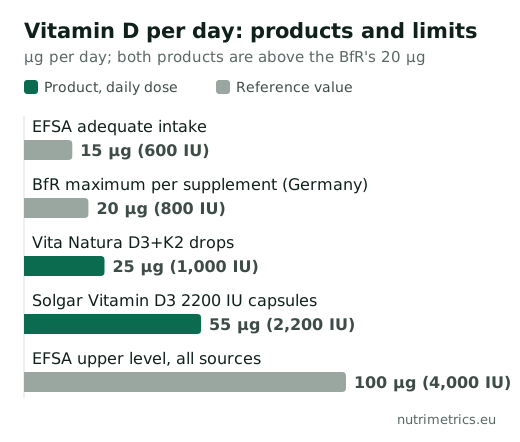
| Vita Natura D3+K2 drops, 50 ml (about 1,700 drops) | 25 µg (1,000 IU) | €23.99 (docmorris.de) | ~€0.01 |
| Solgar Vitamin D3 2200 IU, 50 capsules | 55 µg (2,200 IU) | €17.95 (mccabespharmacy.com, Ireland) | ~€0.36 |
Prices checked 15 October 2026. Both are below the NHS and EFSA maximum of 100 µg but above the BfR’s recommended maximum per supplement. In this case the drops cost about 25 times less per day, which is why cost per day is the number to compare.
Our goal finder lists the vitamin D products we have checked so far.
Talk to your GP or pharmacist before taking vitamin D if you have kidney disease, sarcoidosis or high calcium levels, or take thiazide diuretics or blood thinners.
FAQ
How many IU is 1 µg of vitamin D?
1 µg equals 40 IU. So 10 µg is 400 IU, 25 µg is 1,000 IU and 100 µg is 4,000 IU.
Should I take vitamin D all year in the UK?
The NHS says most people can make enough vitamin D from sunlight from about late March to the end of September. All-year supplements are advised for people who are rarely outdoors, live in a care home, cover most of their skin outdoors or have dark skin, and for all children aged 1 to 4.
What about babies and young children?
The NHS advises 8.5 to 10 µg a day from birth for breastfed babies, and for formula-fed babies having less than 500 ml of formula a day. Children aged 1 to 4 should have 10 µg a day all year. Families on the Healthy Start scheme can get free vitamins.
Do I need vitamin K2 with vitamin D3?
There is no authorised claim for the combination in the UK or the EU. Vitamin K has its own claims on bones and blood clotting. If you take blood thinners such as warfarin, talk to your GP before taking K2.
Why are vitamin D limits different between countries?
Neither the UK nor the EU has binding maximum amounts for vitamins in supplements, so each country gives its own guidance. The NHS uses 100 µg a day as the maximum for adults; Germany's BfR recommends 20 µg per daily dose; Spain has no national limit.
Is there vegan vitamin D3?
Yes. Most vitamin D3 is made from lanolin in sheep's wool, but D3 from lichen is suitable for vegans. The label will say so.
Sources
- NHS — Vitamin D
- SACN (2016) — Vitamin D and health
- SACN — Fortifying foods and drinks with vitamin D: summary (NDNS data on vitamin D status)
- DHSC — Great Britain nutrition and health claims (NHC) register
- European Commission — EU Register of nutrition and health claims
- EFSA (2023) — Scientific opinion on the tolerable upper intake level for vitamin D
- EFSA — Dietary reference values
- Rabenberg M et al. Vitamin D status among adults in Germany — results from DEGS1. BMC Public Health, 2015
- Fernández-Vicente M et al. Influencing variables on total and free 25(OH)D levels in healthy population. Rev Clin Esp, 2022
- BfR — Recommended maximum levels for vitamins and minerals in food supplements
- Tripkovic L et al. Comparison of vitamin D2 and vitamin D3 supplementation in raising serum 25-hydroxyvitamin D status. Am J Clin Nutr, 2012
- NIH Office of Dietary Supplements — Vitamin D fact sheet for health professionals