
Key takeaways
- The UK has no legal maximums either. The NHS gives daily amounts from supplements that are unlikely to cause harm: vitamin D 100 µg, vitamin B6 10 mg, magnesium 400 mg, zinc 25 mg, iron 17 mg, selenium 350 µg.
- There are no EU-wide legal maximums for vitamins and minerals in supplements yet. Each country decides, and the differences are large: vitamin D ranges from 20 µg/day (Germany, Austria) to 100 µg/day (Ireland).
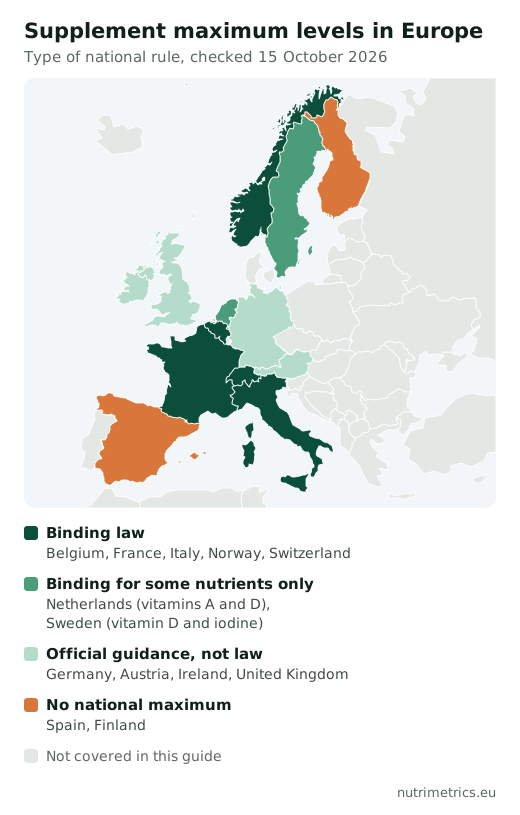
- Some limits are law (Belgium, France, Italy, Netherlands, Sweden, Norway, Switzerland), others are guidance (Germany, Austria, Ireland, UK), and some countries set none (Spain, Finland).
- Under EU mutual recognition, a supplement lawfully sold in one member state can usually be sold in another even if it exceeds that country's limit, unless the authority shows a specific health risk.
- Melatonin is the starkest split: a prescription-only medicine in the UK and Switzerland, a food supplement below 2 mg in Spain and France, and below 0.3 mg in Belgium and the Netherlands.
The UK in one table
The UK sets no legal maximum for vitamins and minerals in food supplements. The NHS publishes, for each nutrient, the daily amount from supplements that the Department of Health and Social Care considers unlikely to cause harm. Inspectors and responsible brands work to these figures, which come from the 2003 report of the Expert Group on Vitamins and Minerals.
| Nutrient | NHS: from supplements, per day | UK daily need (adults) |
|---|---|---|
| Vitamin D | No more than 100 µg (4,000 IU); 50 µg for ages 1–10 | 10 µg |
| Vitamin B6 | No more than 10 mg unless a doctor advises | 1.4 mg men, 1.2 mg women |
| Vitamin C | Less than 1,000 mg unlikely to cause harm | 40 mg |
| Vitamin B12 | 2 mg or less unlikely to cause harm | 1.5 µg |
| Biotin | 0.9 mg or less unlikely to cause harm | — |
| Folic acid | 1 mg or less unlikely to cause harm | 200 µg folate (400 µg folic acid before and in early pregnancy) |
| Vitamin A | No more than 1.5 mg a day from food and supplements combined; avoid supplements in pregnancy | 700 µg men, 600 µg women |
| Magnesium | 400 mg or less unlikely to cause harm | 300 mg men, 270 mg women |
| Zinc | No more than 25 mg unless a doctor advises | 9.5 mg men, 7 mg women |
| Iron | 17 mg or less unlikely to cause harm (follow your GP if prescribed more) | 8.7 mg; 14.8 mg for women aged 19–49 |
| Selenium | 350 µg or less unlikely to cause harm | 75 µg men, 60 µg women |
| Iodine | 0.5 mg (500 µg) or less unlikely to cause harm | 140 µg |
Figures from the NHS vitamins and minerals pages, checked 30 October 2026. Northern Ireland follows EU food law, which also has no harmonised maximums, so in practice the same figures apply there. Under the UK-EU SPS agreement being negotiated for mid-2027, Great Britain would follow EU food supplement rules again, including any EU-wide maximums the EU adopts later.
Why the limits differ from country to country
The EU harmonised which vitamins and minerals may go into supplements, and in which chemical forms, back in 2002. It also said the Commission would set common maximum amounts. That second step has never happened, so every country fills the gap itself.
The result is three kinds of market:
- Binding law. The maximum is in a decree or regulation and applies to every product made or notified there: Belgium, France, Italy, the Netherlands (vitamins A, D and B6 only), Sweden (vitamin D and iodine only), Norway and Switzerland.
- Official guidance. An authority publishes “safe” figures that inspectors use, but they are not law: the UK (Expert Group on Vitamins and Minerals and NHS advice), Germany (BfR), Austria and Ireland (FSAI).
- No national maximum. Spain and Finland set no general limits; authorities judge products case by case against EFSA’s safety levels.
Are EU-wide maximums coming? The European Commission is preparing them, and its plan lists adoption for the first quarter of 2028. In October 2026, however, it said no public consultation is planned for this year and gave no new timetable. Long transition periods are likely after adoption. Until then, national rules apply.
Maximum daily dose per country
Maximum amount per recommended daily dose of a food supplement, for adults. ”—” means no national maximum.
Limits are per recommended daily dose of a supplement, for adults; several countries set lower ones for children and teenagers. Inside the EU, a product lawfully sold in one country can usually be sold in another even above its limit (mutual recognition).
Figures checked against national sources and the Verbraucherzentrale comparison (September 2025) on 15 October 2026; UK figures checked against the NHS on 30 October 2026. Several countries set separate, lower limits for children and teenagers.
Melatonin
| Country | Status | What the rule says | Source |
|---|---|---|---|
| Spain | Supplementbelow 2 mg/day | Food supplement below 2 mg a day; from 2 mg it counts as a medicine (AEMPS criterion). That is why so many Spanish products contain 1.9–1.99 mg. | Basque Government — Use of melatonin in food supplements (AESAN/AEMPS criterion) |
| France | Supplementbelow 2 mg/day | Food supplements may provide less than 2 mg a day; higher doses are medicines. ANSES advises pregnant and breastfeeding women, children, teenagers and people with some conditions not to take melatonin supplements. | Ordre national des pharmaciens — ANSES advice on melatonin supplements (French) |
| Italy | Supplementmax. 1 mg/day | Food supplements may provide at most 1 mg a day (Ministry of Health, June 2013; previously 5 mg). Above that, melatonin is treated as a medicine. | Altroconsumo — Melatonina (Italian) NutraIngredients — Italy cuts maximum melatonin levels from 5 mg to 1 mg (2013) |
| Portugal | Supplementmax. 1 mg/day | The food authority DGAV accepts supplement notifications only up to 1 mg a day, and not for children (2016 opinion on the boundary between medicines and supplements). | DGAV — Opinion on melatonin in food supplements, July 2016 (Portuguese) |
| Belgium | Supplementbelow 0.3 mg | The medicines agency (FAGG/AFMPS) treats oral products with 0.3 mg or more as medicines, and products absorbed in the mouth (sprays, melts) from 0.2 mg. That is why Belgian supplements contain about 0.29 mg. | Habraken H et al. Melatonine bij kinderen met slapeloosheid? Tijdschrift voor Jeugdgezondheidszorg, 2022 (Dutch) Luxembourg Ministry of Health — Answer to parliamentary question 3172 on melatonin, 2017 (French) |
| Netherlands | Supplementbelow 0.3 mg/day | A food supplement only below 0.3 mg a day and without any health claim; from 0.3 mg it is a medicine that needs a marketing authorisation (IGJ and NVWA). | Dutch government — Answers to parliamentary questions on melatonin, 2019–2020 no. 297 (Dutch) IGJ and NVWA — Letter on stepped-up supervision of melatonin products (Dutch) |
| Germany | Disputedno legal limit | No legal maximum. The federal institutes have regarded melatonin as a medicine since 1996, but the federal states decide and courts have ruled both ways; supplements with 0.5–1.5 mg a day are widely sold. Melatonin medicines are prescription-only. | BfR — Melatonin-containing food supplements: possible health risks (Opinion 038/2024, German) Verbraucherzentrale NRW — Melatonin zum Einschlafen (German) PTA heute — Wie viel Melatonin in NEM ist erlaubt? (2022, German) |
| Denmark | Medicine only | Melatonin products are medicines and need a prescription. A product sold as a supplement elsewhere is generally treated as a medicine when it is sent to Denmark, and medicines may not be received from outside the EU/EEA. | Danish Medicines Agency — Are you considering buying melatonin online? |
| Sweden | Medicine only | A medicine (prescription and some non-prescription medicines). Selling it as a food supplement is illegal; the Medical Products Agency has banned the sale of several such products. | Läkemedelsverket — Risk that melatonin is used too lightly (press release, 24 March 2025, Swedish) |
| Ireland | Medicine only | A prescription-only medicine that is not authorised in food. The food safety authority FSAI recalls supplements that contain it (most recently in May 2026). | FSAI — Medicinal product (melatonin) not permitted in food: Jelly Pills supplements (alert 2026.29, 29 May 2026) |
| United Kingdom | Medicine only | A prescription-only medicine: the MHRA says any product containing melatonin is a medicine, so melatonin supplements are illegal in the UK. | MHRA — Parents advised to stop using a brand of kids' magnesium gummies containing undeclared melatonin (18 August 2025) |
| Switzerland | Medicine only | Only as a prescription medicine; selling it as a food or food supplement is prohibited. Swissmedic warns against importing it privately (warning of 27 November 2023). | Swissmedic — Warning about imports of melatonin and DHEA by private individuals (27 November 2023) |
| EU level | EU-wide | No EU-wide maximum: each country sets its own rule. Two authorised claims: falling asleep faster (1 mg shortly before bedtime) and jet lag (at least 0.5 mg). A product lawful in one EU country can often be sold in another (mutual recognition). | European Commission — EU Register of nutrition and health claims |
National rules change. Check the date and the source before you rely on a row.
The biggest differences, in plain numbers
- Vitamin D: a 4,000 IU (100 µg) tablet sold legally in the UK or Ireland is five times the German and Austrian guidance level and above the binding limits in Belgium, the Netherlands, Italy, France, Sweden, Norway and Switzerland.
- Zinc: Switzerland allows 5.3 mg per day and Germany advises 6.5 mg, while the UK and Ireland use 25 mg. A standard 25 mg zinc tablet is five times the Swiss limit.
- Vitamin B6: Germany’s 0.9 mg proposal sits next to 10 mg in the UK and 25 mg in Ireland’s guidance. Ireland’s figure predates EFSA’s 2023 decision to cut the B6 safety level from 25 mg to 12 mg; the NHS figure of 10 mg is already below it.
- Magnesium: Belgium and Italy allow 450 mg, almost double the 250 mg EFSA level for supplemental magnesium. EFSA’s level is set to avoid diarrhoea, not serious harm.
How a product can be legal where it exceeds the limit
This is the part most shoppers never hear about. Inside the EU, the principle of mutual recognition (Articles 34–36 of the Treaty on the Functioning of the EU, now organised by Regulation (EU) 2019/515) says: if a product is lawfully marketed in one member state, another member state cannot simply ban it because its own national rules differ.
In practice:
- A brand notifies a 75 µg vitamin D supplement in Belgium, where that is legal.
- It then sells the same product in Germany, where the BfR guidance is 20 µg, or in Italy, where the binding limit is 50 µg.
- The German or Italian authority can only stop it with a reasoned, product-specific decision showing a real risk to health. Since 2020 the seller can back its case with a “mutual recognition declaration” under Regulation 2019/515.
The Court of Justice confirmed in the Noria Distribution case (C-672/15, 2017) that countries may set their own maximums while the EU has none, but those maximums must rest on a proper scientific risk assessment, not a blanket precaution.
Outside the EU the picture changes:
- Norway applies the same principle through the EEA Agreement.
- Sweden has a built-in escape valve: a business can apply for a dispensation from the 80 µg vitamin D and 200 µg iodine limits if it shows the higher dose is safe.
- Switzerland recognises EU-lawful products under its own “Cassis de Dijon” rule, but foods need prior clearance from the Federal Food Safety Office (FSVO/BLV) before they can rely on it.
- United Kingdom: since Brexit there is no mutual recognition with the EU for Great Britain. A supplement sold in GB must use the vitamin and mineral forms permitted under GB law, carry only claims from the GB register and, since 1 January 2024, show a UK address for the business responsible. Northern Ireland still follows EU food rules. The UK-EU SPS agreement planned for mid-2027 would bring Great Britain back in line with EU food supplement rules.
What this means for you: the dose on a label tells you what was legal where the product was first put on the market, not necessarily what your own country considers safe. Products shipped from outside the EU, such as US brands sold through marketplaces, get no mutual-recognition protection at all.
What each ingredient does, and what too much can do
The benefits below are limited to what authorised health claims allow (the GB and EU registers match for these nutrients). They are not medical advice. Talk to a doctor or pharmacist before taking high doses, especially with medication, in pregnancy or for children.
Vitamin D
- Role: contributes to normal absorption of calcium and phosphorus, normal bones, teeth and muscle function, and normal immune function.
- Too much: builds up in body fat over time and can raise blood calcium (hypercalcaemia), which can damage the kidneys and heart. Risk comes from high-dose supplements, not sun or food.
Vitamin B6
- Role: contributes to normal energy-yielding metabolism, normal nervous system function and the reduction of tiredness and fatigue.
- Too much: long-term high intake is linked to peripheral neuropathy (tingling and numbness in hands and feet). This is why EFSA halved its safety level to 12 mg in 2023, and why the NHS advises no more than 10 mg a day from supplements. Watch for B6 hidden in magnesium and “sleep” complexes.
Folic acid
- Role: contributes to normal blood formation and maternal tissue growth during pregnancy; 400 µg a day before and in early pregnancy reduces the risk of neural tube defects.
- Too much: high intakes can mask vitamin B12 deficiency, letting nerve damage progress unnoticed.
Magnesium
- Role: contributes to normal muscle and nerve function, energy metabolism, electrolyte balance and the reduction of tiredness and fatigue.
- Too much: the main effect of supplemental magnesium above about 250 mg (EFSA) or 400 mg (NHS) is a laxative one (diarrhoea, cramps). People with kidney disease should not take it without medical advice.
Zinc
- Role: contributes to normal immune function, fertility, skin, hair and nails, and protection of cells from oxidative stress.
- Too much: long-term high intake blocks copper absorption and can cause anaemia and low white blood cell counts.
Selenium
- Role: contributes to normal thyroid function, immune function, hair and nails, and protection of cells from oxidative stress.
- Too much: the earliest sign of excess is hair loss and brittle nails. Two or three Brazil nuts a day already supply a lot of selenium.
Iodine
- Role: contributes to the normal production of thyroid hormones and normal cognitive function.
- Too much: excess can trigger thyroid over- or underactivity, particularly in people with existing thyroid disease. Kelp and seaweed supplements can be extremely high in iodine.
Melatonin
- Role: 1 mg taken close to bedtime contributes to reducing the time it takes to fall asleep; 0.5 mg helps relieve the subjective feeling of jet lag.
- Too much: daytime drowsiness, headache and dizziness; it interacts with some medicines and alcohol. Higher doses do not work better for most people, which is why several countries keep supplement doses low.
How to read a label wherever you live
- Check the dose per daily serving, not per tablet or per 100 g.
- Compare it with the line for your country in the tables above: in the UK, the NHS figure; elsewhere, the national limit and the EFSA level.
- Add up the same nutrient across all products you take: a multivitamin plus a vitamin D tablet plus fortified milk can double your intake.
- Treat any product above the NHS or EFSA level as something to discuss with a GP or pharmacist, even if it is legal to sell.
This guide is general information, not medical advice. Limits change; we re-check the sources in this article every six months.
FAQ
Is there a legal maximum dose for supplements in the UK?
No. UK law (the Food Supplements Regulations 2003 for England and their Scottish and Welsh equivalents) lists which vitamins and minerals may be used and in which forms, but sets no maximum amounts. The figures used in practice are the Expert Group on Vitamins and Minerals' 2003 safe upper levels and the NHS advice built on them.
Is there an EU maximum dose for vitamin D in supplements?
Not yet. The 2002 Food Supplements Directive provides for EU maximum levels, but the European Commission has never adopted them. EFSA's tolerable upper intake level of 100 µg/day for adults is a safety benchmark for total intake, not a legal limit. The Commission's own timetable puts EU maximums no earlier than 2028.
Can a shop sell a supplement that exceeds my country's limit?
Often yes, inside the EU and EEA, if the product is lawfully on the market in another member state. The authority in the country of sale can only block it with a justified, product-specific decision based on a health risk.
Do these limits apply to products I buy online from abroad?
Inside the EU, products shipped from another EU country follow the rules where they were lawfully marketed. Great Britain is outside that system: products sold there must meet GB rules, and since 2024 their labels need a UK address. Products from outside the UK and EU (for example the US) have no such protection and may be illegal to sell where you live.
Why are the German figures so low?
Germany's BfR starts from EFSA's safety level and subtracts what 15–17-year-olds with very high intakes already get from food, the most sensitive group. What is left is the amount that can be added through supplements. The figures are proposals, not binding law.
Sources
- NHS — Vitamins and minerals (vitamin D, B vitamins, iron, others)
- NHS — Others (magnesium, selenium, zinc)
- NHS — Iodine
- The Food Supplements (England) Regulations 2003
- GOV.UK — Food labelling: giving food information to consumers (UK address since 1 January 2024)
- Defra — UK-EU SPS Agreement: legislation in scope
- Verbraucherzentrale — Höchstmengen für Vitamine und Mineralstoffe in Europa (Sept 2025)
- EFSA — Overview of Tolerable Upper Intake Levels (2024)
- BfR — Updated maximum level proposals for food supplements (Feb 2024)
- Ministero della Salute — Apporti giornalieri di vitamine e minerali ammessi negli integratori (2021)
- Lovdata — Forskrift om kosttilskudd (Norway), Vedlegg 1
- Swiss VNem — Verordnung des EDI über Nahrungsergänzungsmittel, Anhang 1
- Austria — Empfehlung zu Mengen von Vitaminen und Mineralstoffen (2016)
- Livsmedelsverket — Föreskrifter om kosttillskott (Sweden, TRIS 2022/0395/S)
- Netherlands — Warenwetregeling vrijstelling voedingssupplementen (TRIS 2017/0546/NL)
- AESAN — Complementos alimenticios (Spain)
- AEMPS — Withdrawal of a 3 mg melatonin supplement (medicine above 2 mg)
- UK Expert Group on Vitamins and Minerals — Safe Upper Levels (2003)
- Vanhee et al., Molecules 2025 — melatonin regulation in Europe (Table 1)
- HBW Insight — Commission says no 2026 consultation planned on EU supplement limits (22 Oct 2026)
- Verbraucherzentrale — Wann gibt es endlich Höchstmengen? (1 Jul 2026, German)
- Regulation (EU) 2019/515 on mutual recognition of goods