
Key takeaways
- The NHS says most people do not need vitamin supplements if they eat a healthy, balanced diet. The exceptions it names are vitamin D in autumn and winter, folic acid before and in early pregnancy, and vitamins A, C and D for children aged 6 months to 5 years.
- In a study of 390,124 US adults followed for over 20 years, daily multivitamin users did not live longer than non-users.
- The US Preventive Services Task Force found insufficient evidence that multivitamins prevent heart disease or cancer, and recommends against beta-carotene and vitamin E supplements.
- Two trials stand out: 8% fewer cancers in male doctors over 50, and slower memory decline in older adults. Both used the same brand and need confirming.
- If you buy one, aim for about 100% of the NRV, skip iron unless you need it, and avoid beta-carotene if you smoke.
The short answer
For most adults who eat reasonably well, a multivitamin is unlikely to prevent heart disease or cancer or help you live longer. It can make sense as a cheap way to fill a specific gap: B12 on a vegan diet, folic acid before pregnancy, or a very limited diet. If you take one, choose a modest formula rather than a high-dose one.
What the big studies found
| Study | Who | What it found |
|---|---|---|
| NIH analysis, 2024 | 390,124 US adults, followed for over 20 years | Daily multivitamin users did not have a lower risk of death from any cause |
| Physicians’ Health Study II, cancer (2012) | Nearly 15,000 male US doctors aged 50+, for over a decade | 8% fewer cancers: 17.0 vs 18.3 per 1,000 men per year |
| Physicians’ Health Study II, heart (2012) | Same men | No reduction in major cardiovascular events |
| COSMOS trials, combined (2024) | About 5,000 older US adults, 2–3 years | Slower decline in memory and overall thinking, equal to about two years of cognitive ageing |
| US Preventive Services Task Force (2022) | Review of all trials | Insufficient evidence for multivitamins; recommends against beta-carotene and vitamin E |
Three things to keep in mind:
- Most of the data is American, where many foods are fortified differently from Europe.
- PHS II and COSMOS both tested Centrum Silver. The results may not apply to other formulas.
- The mortality study is observational. It can show that multivitamin users don’t live longer, but not why.
The cancer and memory findings are interesting, but each comes from a single research programme. Neither has led an official body to recommend multivitamins for prevention.
Who may benefit
A multivitamin is a blunt tool, but it can help when you know there is a gap. The NHS names these groups:
- Everyone in autumn and winter: 10 µg of vitamin D a day, all year for people who are rarely outdoors, cover their skin or have dark skin.
- Planning a pregnancy or pregnant: 400 µg of folic acid a day before conception and until 12 weeks; the US Task Force recommends the same. Choose a pregnancy-specific product without vitamin A as retinol.
- Children aged 6 months to 5 years: a daily supplement with vitamins A, C and D. Families on the Healthy Start scheme can get them free.
- Vegans: vitamin B12 is essential; see our vitamin B12 guide. A targeted B12 supplement is often simpler than a multivitamin.
- People eating very little, for example after illness or in older age, or on very restrictive diets: ask your GP whether a test or a multivitamin makes sense.
What to check on the label
- About 100% of the NRV. UK and EU law let a product claim benefits for a nutrient from just 15% of the NRV per daily dose. Formulas with 500% or more cost more and add risk for some nutrients, without proven benefit.
- Iron only if you need it. Men and post-menopausal women usually don’t. Germany’s BfR recommends they take iron only after medical advice. Our iron guide explains the ferritin test.
- No beta-carotene if you smoke. The US Task Force recommends against beta-carotene supplements, which raised lung cancer risk in people who smoke.
- Vitamin A as retinol. The NHS advises no more than 1.5 mg (1,500 µg) of vitamin A a day from food and supplements combined, and avoiding vitamin A supplements in pregnancy; EFSA’s safe upper level is 3,000 µg. Pregnant women should use a pregnancy-specific product.
- Vitamin B6 at 10 mg or less a day from supplements, the NHS figure (EFSA’s safe upper level is 12 mg in total).
- Vitamin D: many multivitamins give 5 µg, which is 100% of the NRV but only half of the 10 µg the NHS advises in autumn and winter. See vitamin D in winter.
How to choose a multivitamin without iron
Men and women over 50 need 8.7 mg of iron a day, according to the NHS, and most get that from food. Germany’s BfR advises men and post-menopausal women to take iron only after medical advice, and people with haemochromatosis must avoid it. If that applies to you, look for a formula without iron:
- Read the nutrition table, not the name. “50+”, “men” and “senior” versions often contain less iron, not none: both 50+ formulas in the table below still give 2.1 to 4.2 mg.
- Check the ingredients list for iron compounds: ferrous fumarate, ferrous bisglycinate, ferrous sulphate, ferrous gluconate or ferric pyrophosphate.
- Search for “iron-free”, then confirm it on the label itself: a shop’s product title is not the label.
- Don’t drop iron without a reason if you have heavy periods, are pregnant or eat no meat: ask for a ferritin test first.
Is the vitamin D in your multivitamin a safe amount?
On its own, almost always. The three labels below give 5 to 15 µg of vitamin D, far below EFSA’s safe upper level of 100 µg a day for adults and within the NHS figure of 100 µg from supplements.
The risk comes from stacking: a multivitamin, plus a separate vitamin D tablet, plus fortified foods. A multivitamin with 25 µg and a 100 µg (4,000 IU) vitamin D3 tablet already give 125 µg, above EFSA’s level. If you take both, add them up.
Countries also set their own maximum per daily dose of a product. For the nutrients that matter most in a multivitamin:
| Nutrient | EFSA safety level (UL) | United Kingdom · Guidance (NHS) | Ireland · Guidance | Germany · Guidance (BfR) |
|---|---|---|---|---|
| Vitamin D | 100 µg | 100 µg | 100 µg | 20 µg |
| Vitamin B6 | 12 mg | 10 mg | 25 mg | 0.9 mg |
| Folic acid | 1,000 µg | 1,000 µg | 1,000 µg | 200 µg |
| Magnesium | 250 mg (supplements only) | 400 mg | 250 mg | 250 mg |
| Zinc | 25 mg | 25 mg | 25 mg | 6.5 mg |
| Selenium | 255 µg | 350 µg | 300 µg | 40 µg |
| Iodine | 600 µg | 500 µg | 600 µg | 100 µg |
Limits are per recommended daily dose of a supplement, for adults; several countries set lower ones for children and teenagers. Inside the EU, a product lawfully sold in one country can usually be sold in another even above its limit (mutual recognition). All 7 nutrients and 13 countries →
EFSA — Overview of tolerable upper intake levels (2024)
NHS — Vitamins and minerals
Verbraucherzentrale — Höchstmengen für Vitamine und Mineralstoffe in Europa (Sept 2025)
BfR — Höchstmengenvorschläge für Nahrungsergänzungsmittel (2024)
Three labels compared
| Product (our database, Spain and Germany) | Vitamin D | Iron | Vitamin A | B12 |
|---|---|---|---|---|
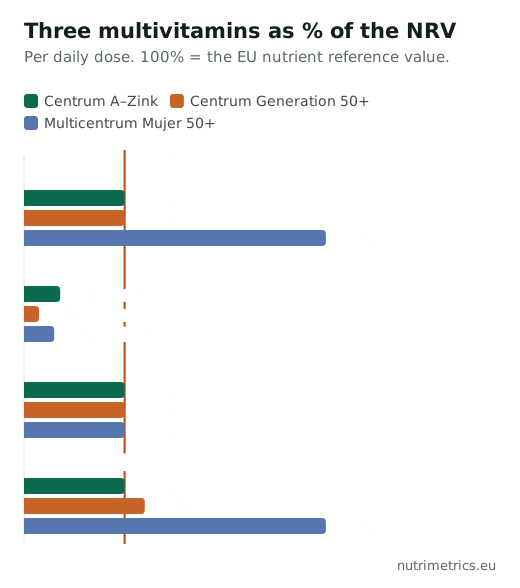
| Centrum A–Zink (Germany) | 5 µg | 5 mg | 800 µg (25% as beta-carotene) | 2.5 µg |
| Centrum Generation 50+ (Germany) | 5 µg | 2.1 mg | 800 µg | 3 µg |
| Multicentrum Mujer 50+ (Spain) | 15 µg | 4.2 mg | 800 µg (50% as beta-carotene) | 7.5 µg |
All three stay close to 100% of the NRV for most nutrients. The Spanish women’s formula gives three times more vitamin D than the German ones. The two 50+ formulas still contain some iron, which many post-menopausal women don’t need, and smokers should note the beta-carotene in both Centrum A–Zink and Multicentrum Mujer 50+.
Compare all the multivitamins we have checked on our multivitamins page, and see the NHS figures and the limits by country in supplement maximum levels.
FAQ
Are multivitamins a waste of money?
For most well-fed adults, the evidence says they don't prevent heart disease, cancer or early death. They make more sense if your diet has a known gap, such as B12 on a vegan diet or folic acid before pregnancy.
Do multivitamins improve memory?
The COSMOS trials found that older adults taking a daily multivitamin had slower cognitive decline over two to three years, equal to about two years of ageing. It is a promising result from one research programme and one product, not settled advice.
Should a multivitamin contain iron?
Only if you need it. Men and post-menopausal women usually don't, and Germany's BfR recommends they take iron only after medical advice. The NHS says 17 mg or less a day of iron from supplements is unlikely to cause harm. Women with periods or a confirmed low ferritin may benefit.
How do I find a multivitamin without iron?
Check the nutrition table rather than the product name: "50+" or "men" versions often contain less iron, not none. Look for iron compounds such as ferrous fumarate or ferrous bisglycinate in the ingredients. If you have heavy periods, are pregnant or eat no meat, get a ferritin test before you drop iron.
Which multivitamins contain a safe amount of vitamin D?
On its own, the vitamin D in a multivitamin is well below EFSA's safe upper level of 100 µg a day for adults: the three labels we compared give 5 to 15 µg. The risk is adding a separate high-dose vitamin D tablet on top, so add up everything you take. National maximums per daily dose range from 20 µg (Germany, Austria) to 100 µg (UK, Ireland).
How much of each vitamin should a multivitamin have?
Around 100% of the reference intake on UK and EU labels (NRV) for most nutrients is enough. Products need only 15% of the NRV to make a claim, and several hundred percent adds cost without proven benefit.
Is a multivitamin enough vitamin D in winter?
Often not. Many contain 5 µg, which is 100% of the NRV but only half of the 10 µg a day the NHS advises in autumn and winter (and a third of EFSA's adequate intake of 15 µg). You may still need a separate vitamin D supplement.
Sources
- NHS — Do I need vitamin supplements?
- NHS — Vitamin A
- NHS — B vitamins and folic acid
- NHS — Vitamin D
- NIH — For healthy adults, taking multivitamins daily is not associated with a lower risk of death (Loftfield et al., JAMA Netw Open, 2024)
- US Preventive Services Task Force — Vitamin, mineral and multivitamin supplementation to prevent cardiovascular disease and cancer (2022)
- Harvard Health — Daily multivitamin-multimineral may help protect against cancer (Physicians' Health Study II, 2012)
- Healio — Daily multivitamin failed to reduce major CVD risk in middle-aged men (PHS II, 2012)
- NutraIngredients — COSMOS: multivitamins linked to improved memory, slower age-related cognitive decline (Vyas et al., Am J Clin Nutr, 2024)
- NIH Office of Dietary Supplements — Multivitamin/mineral supplements fact sheet
- EFSA — Summary of tolerable upper intake levels (2024)