
Key takeaways
- Vegans need B12 from supplements or fortified foods. The NHS notes that B12 is not found naturally in plant foods, so vegans may not get enough.
- The NHS says adults need about 1.5 µg a day and that 2 mg (2,000 µg) or less a day from supplements is unlikely to cause harm.
- The Vegan Society's three options: at least 3 µg a day from fortified foods, a 10 µg daily supplement, or a 2,000 µg weekly one.
- Labels show 500–1,000 µg because absorption falls sharply with the dose: only about 1.3% of a 1,000 µg tablet is absorbed.
- There is no evidence that methylcobalamin is absorbed better than cheaper cyanocobalamin. Older adults and people on metformin or acid-reducing medicines should ask for a B12 test.
The short answer
If you eat animal products most days and have no absorption problems, you probably don’t need a B12 supplement: the NHS says you should be able to get enough from meat, fish or dairy, and Germany’s BfR says supplements are unnecessary for healthy people with a balanced diet that includes animal foods. If you are vegan, you do need one, or fortified foods, every week of your life. If you are older or take metformin or acid-reducing medicines, ask your GP for a blood test before buying anything.
Who is most at risk
According to the US National Institutes of Health (NIH), these groups are most likely to run low:
- Vegans, and vegetarians who eat few eggs or dairy products. Breastfed babies of vegan mothers are also at risk.
- Older adults. In US data from 2007–2018, 3.7% of people aged 60 and over were deficient and 12.3% had low-normal levels.
- People taking metformin, which can reduce B12 absorption and blood levels.
- People taking proton pump inhibitors (such as omeprazole) or H2 blockers, which reduce the stomach acid needed to release B12 from food.
- People who have had stomach or weight-loss surgery.
- People with pernicious anaemia, an autoimmune condition and the most common cause of B12 deficiency in the UK. It needs medical treatment, usually injections on the NHS, not a shop-bought supplement.
Why labels say 1,000 µg
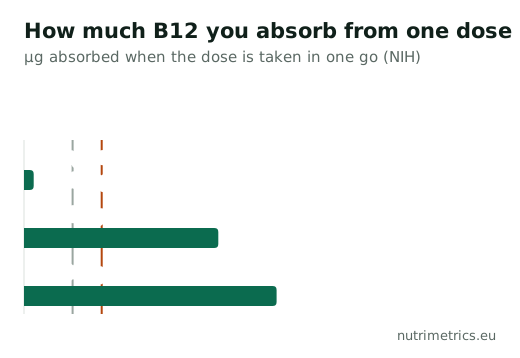
The reference intake on UK and EU labels (NRV) is 2.5 µg a day; the NHS puts adult needs at about 1.5 µg, and EFSA’s adequate intake is 4 µg. Yet most B12 products contain 500 or 1,000 µg. The reason is absorption: the body’s main uptake route saturates at very small amounts.
| Dose in one go | Share absorbed (NIH) | Roughly absorbed |
|---|---|---|
| About 1 µg | About 50% | 0.5 µg |
| 500 µg | About 2% | 10 µg |
| 1,000 µg | About 1.3% | 13 µg |
So a 1,000 µg tablet is less extreme than it looks. It is also why small doses spread through the day, such as fortified foods eaten two or three times, work well.
How much to take
For vegans, the UK’s Vegan Society gives three equivalent options:
| Option | Amount |
|---|---|
| Fortified foods, two or three times a day | At least 3 µg a day in total |
| Daily supplement | At least 10 µg |
| Weekly supplement | At least 2,000 µg |
In the UK, the NHS says up to 2 mg (2,000 µg) a day from supplements is unlikely to cause harm, so all three options sit well inside it. Germany’s BfR takes a much more cautious line for products sold freely: it recommends no more than 25 µg per daily dose. That is a recommendation, not a legal limit, and many products exceed it. If you prefer to stay within it, a 10–25 µg daily tablet covers the Vegan Society’s daily option. For a diagnosed deficiency, your GP will decide the dose, often much higher, or use injections.
Which form to buy
You will see cyanocobalamin, methylcobalamin, adenosylcobalamin and hydroxocobalamin, often with claims that one is “active” or “better absorbed”. The NIH states that there is no evidence that absorption differs by form, and that tablets dissolved under the tongue work no better than swallowed ones. Cyanocobalamin is the most studied and usually the cheapest. Drops, sprays and chewables are fine if they suit you; compare the µg per day.
Getting tested
If you think you might be low, ask your GP for a blood test. The NIH gives these reference points:
- Serum B12: most labs call results below 200–250 pg/ml (about 150–185 pmol/l) low.
- Borderline results (150–399 pg/ml) are worth following up with methylmalonic acid (MMA), the more sensitive marker. MMA above 0.271 µmol/l suggests deficiency, although kidney problems also raise it.
Tiredness, pins and needles or memory problems can have many causes. A test tells you whether B12 is one of them.
What a B12 label may claim
UK and EU law (the Great Britain and EU registers match here) allow vitamin B12 to claim that it contributes to normal energy-yielding metabolism, the normal function of the nervous and immune systems, normal psychological function, normal red blood cell formation, normal homocysteine metabolism, cell division and the reduction of tiredness and fatigue. A product needs only 0.375 µg per daily dose (15% of the NRV) to use these claims. No claim says B12 gives extra energy to people with normal levels.
Examples from our database
Checked for our Spanish and German editions; UK products are next.
- Solgar Vitamin B12 1000 µg (chewable, Spain): 1,000 µg cyanocobalamin a day.
- Yes Vegan! Vitamin B Komplex (Germany): 500 µg B12 plus 400 µg folate a day.
- Multicentrum Mujer 50+ (Spain): 7.5 µg B12 as part of a multivitamin.
See every B12 product we have checked, with doses side by side, on our vitamin B12 page. For other nutrients a vegan diet needs to plan for, see omega-3: fish oil or algae oil and iron and tiredness.
FAQ
Who should take a vitamin B12 supplement?
Vegans, and vegetarians who eat few eggs or dairy products. Older adults, people taking metformin or acid-reducing medicines, and people who have had stomach surgery are also at higher risk of low B12 and should ask their GP for a test.
How much vitamin B12 do vegans need?
The Vegan Society recommends at least 3 µg a day from fortified foods, or a supplement giving at least 10 µg a day, or at least 2,000 µg once a week. The larger amounts make up for the small share absorbed from big doses.
Is methylcobalamin better than cyanocobalamin?
According to the US National Institutes of Health, there is no evidence that absorption differs by form. Cyanocobalamin is the most studied and usually the cheapest.
Can you take too much vitamin B12?
The NHS says taking 2 mg or less a day of vitamin B12 in supplements is unlikely to cause any harm. Neither EFSA nor the US authorities have set a safe upper level, because B12 has a low potential for harm. Germany's BfR is far stricter and recommends no more than 25 µg per daily dose in freely sold supplements. Doctors use much higher doses to treat a confirmed deficiency.
Will B12 give me more energy?
Only if you are low in it. UK and EU law allow B12 to claim it contributes to the reduction of tiredness and fatigue, but that applies to a normal intake, not to extra energy in people whose levels are fine.
Sources
- NHS — B vitamins and folic acid
- UHCW NHS Trust — Dietary advice for vitamin B12 and folate deficiency
- DHSC — Great Britain nutrition and health claims (NHC) register
- NIH Office of Dietary Supplements — Vitamin B12 fact sheet for health professionals
- EFSA (2015) — Dietary reference values for vitamin E and cobalamin (vitamin B12)
- The Vegan Society — What every vegan should know about vitamin B12
- NutraIngredients — German Nutrition Society advises vegans to supplement vitamin B12 (2019)
- BfR — Vitamin B12 infographic, incl. 25 µg maximum per daily dose (German)
- European Commission — EU Register of nutrition and health claims