
Key takeaways
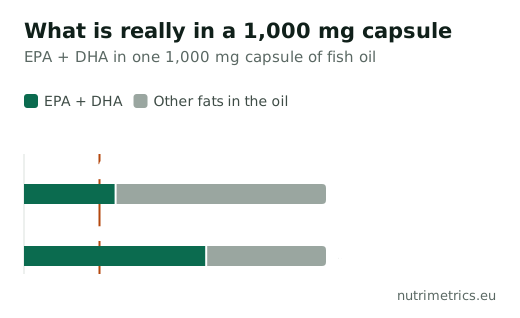
- Compare mg of EPA + DHA per daily dose, not the "1,000 mg fish oil" on the front: a 1,000 mg capsule may hold only 300 mg of omega-3.
- The NHS advises at least 2 portions of fish a week, 1 of them oily. UK dietitians say a supplement, if you use one, should give about 450 mg of EPA + DHA a day, the amount in that diet.
- UK and EU law allow the claims that 250 mg of EPA + DHA contributes to normal heart function and 250 mg of DHA to normal brain function and vision.
- Algae oil raised blood DHA as well as fish oil in a comparison trial and is vegan. Many algae oils are mostly DHA with little EPA.
- EFSA considers up to 5 g a day of supplemental EPA + DHA safe for adults. Germany's BfR advises people with heart disease to consult a doctor because of a possible atrial fibrillation risk at high doses.
The short answer
The NHS advises at least 2 portions of fish a week, 1 of them oily (salmon, mackerel, sardines, herring, trout). If you eat that, you probably already reach the reference intake for omega-3. If not, a supplement with 250–450 mg of EPA + DHA a day matches what EFSA, the authorised health claims and UK dietitians use. Fish oil usually gives more EPA per pound or euro; algae oil is the vegan option and raises blood DHA comparably. Choose by mg of EPA + DHA per dose, not capsule size.
What omega-3 may claim in the UK and EU
The Great Britain register has the same omega-3 claims as the EU register:
| Authorised claim | Condition |
|---|---|
| EPA and DHA contribute to the normal function of the heart | 250 mg EPA + DHA a day |
| DHA contributes to the maintenance of normal brain function | 250 mg DHA a day |
| DHA contributes to the maintenance of normal vision | 250 mg DHA a day |
There are no authorised claims for memory, mood, joints or preventing heart disease. In the UK, NICE tells doctors not to offer omega-3 fatty acid compounds to prevent cardiovascular disease and to tell people there is no evidence that they help (the prescription drug icosapent ethyl is a narrow exception), and the British Dietetic Association says supplements are not recommended for the general population because the evidence of benefit is inconclusive. See our table of approved health claims.
Fish oil, fish liver oil and pregnancy
- Fish oil comes from the body of oily fish and supplies EPA and DHA.
- Fish liver oil (cod liver oil) also contains a lot of vitamin A. The NHS says not to have more than 1.5 mg of vitamin A a day from food and supplements combined, and to avoid fish liver oil if you are pregnant or trying for a baby.
- If you eat oily fish: girls and women who may have a baby one day should have no more than 2 portions of oily fish a week, because of pollutants. Supplements are refined and are not counted in that limit, but check with your midwife or GP before taking one in pregnancy.
Fish oil vs algae oil
| Fish oil | Algae oil | |
|---|---|---|
| Source | Oily fish (anchovy, sardine, mackerel), cod liver | Cultivated microalgae |
| EPA and DHA | Both, often more EPA than DHA | Mostly DHA; some products add EPA |
| Vegan | No | Yes |
| Contaminants | Refined; UK and EU law set limits for dioxins and PCBs in marine oils | Controlled cultivation, no sea exposure |
| Absorption | Benchmark | A 2013 trial found similar blood DHA levels |
| Price per gram EPA + DHA | Usually lower | Usually higher |
The DHA in fish actually comes from the algae they eat. In a 2013 trial, 31 adults took 600 mg of DHA a day for two weeks: algae and fish oil raised blood DHA to similar levels, including in vegetarians and vegans, who started lower.
The label trick: “1,000 mg fish oil”
Many capsules show “1,000 mg” in large print, but that is the total oil. What counts is the milligrams of EPA and DHA, which may be 300 mg in a standard capsule or more than 600 mg in a concentrate. Look for the “of which EPA” and “of which DHA” lines per daily dose.
An example from our database: Norsan Omega-3 Total liquid, sold in Germany, provides 1,040 mg EPA and 600 mg DHA per 8 ml dose, plus 20 µg vitamin D. That is 1,640 mg of EPA + DHA a day — more than six times the reference intake and well below EFSA’s safe level.
How much is too much
- EFSA: up to 5 g a day of supplemental EPA + DHA raises no safety concerns for adults.
- BfR (Germany, 2023): omega-3 preparations may increase the risk of atrial fibrillation in people with existing or impending heart disease, with the highest risk at the highest dose studied, 4 g a day. It advises these people to take them only after consulting a doctor.
Talk to your GP before taking omega-3 if you have heart disease, take blood thinners or are due for surgery.
How to compare prices
Calculate the cost per gram of EPA + DHA:
pack price ÷ daily doses per pack ÷ g EPA + DHA per dose = cost per gram
A cheap algae oil with little DHA per capsule can cost more per gram of omega-3 than a pricier fish-oil concentrate. Keep the pack closed, cool and away from light, and throw away capsules that smell rancid.
Our goal finder lists the omega-3 products we have checked so far, for Spain and Germany; UK products are next.
FAQ
How much omega-3 do I need a day?
UK advice is food-based: at least 2 portions of fish a week (about 140 g each), 1 of them oily. The British Dietetic Association puts that at about 450 mg of EPA + DHA a day. EFSA sets an adequate intake of 250 mg a day, which is also the minimum needed to use the authorised heart and brain claims.
Can I take fish oil when pregnant?
Omega-3 fish oil is different from fish liver oil. The NHS says to avoid fish liver oil supplements, such as cod liver oil, when pregnant or trying for a baby, because they are high in vitamin A. Ask your midwife or GP before taking any supplement in pregnancy.
Is algae oil as good as fish oil?
For DHA, yes: a comparison trial found it raised blood DHA to similar levels. Check the label, because many algae oils supply mostly DHA and little EPA.
Does fish oil contain mercury?
Fish oils are refined, and UK and EU law set maximum levels for contaminants such as dioxins and PCBs in marine oils. Algae oil is cultivated, so it is not exposed to sea pollution.
Can I take omega-3 with blood thinners?
Ask your GP or pharmacist. High doses of omega-3 can affect clotting, and the BfR recommends that people with heart disease take omega-3 preparations only after medical advice.
Is triglyceride-form omega-3 better?
Some brands promote the triglyceride form over ethyl esters. What is clear is that the amount of EPA + DHA per dose matters more than the chemical form.
Sources
- NICE NG238 — Cardiovascular disease: risk assessment and reduction (recommendation 1.12.5)
- NHS — Fish and shellfish
- British Dietetic Association — Omega-3 food fact sheet (via Milton Keynes University Hospital)
- NHS — Vitamin A
- DHSC — Great Britain nutrition and health claims (NHC) register
- European Commission — EU Register of nutrition and health claims
- Commission Regulation (EU) No 432/2012 — list of permitted health claims
- EFSA (2012) — Safety of long-chain omega-3 fatty acids (up to 5 g/day EPA + DHA)
- EFSA — Dietary reference values
- BfR — Omega-3 preparations can increase the risk of atrial fibrillation in heart patients (2023)
- Algal-oil supplements are a viable alternative to fish-oil supplements in terms of DHA. Proc Nutr Soc, 2013
- Commission Regulation (EU) 2023/915 — maximum levels for contaminants in food