
Key takeaways
- UK and EU labels follow the same rules: the UK kept the EU food supplement and labelling law after Brexit. Since 2024, a supplement sold in Great Britain must also show a UK address for the business responsible.
- %NRV compares the daily dose with the reference value for that nutrient, which is the same in the UK and the EU. More than 100% is not better: what matters is staying under the NHS or EFSA upper limits.
- Always compare the amount per daily dose and the number of daily doses per pack, not the capsule count or the weight of the compound.
- The law requires the amount of each nutrient or active substance per daily dose. A "blend" without individual amounts is a red flag.
- No supplement may claim to prevent, treat or cure a disease. If it does, the label breaks the law.
The short answer
Check three things in the nutrition table: the amount of each ingredient per daily dose, how many daily doses the pack contains, and whether any amount exceeds the NHS or EFSA upper limits. Then read the promises on the pack: only claims on the official register are legal (the Great Britain register in England, Scotland and Wales; the EU register in Northern Ireland and the EU), and none may mention diseases.
What the law requires on the label
The UK kept the EU rules: in England they are in the Food Supplements (England) Regulations 2003, with equivalents in Scotland, Wales and Northern Ireland, based on Directive 2002/46/EC. A food supplement label must show:
| Required | Why it helps you |
|---|---|
| The name “food supplement” | Tells it apart from a medicine |
| The nutrients or substances that characterise the product | Shows what you are buying |
| The amount of each per recommended daily dose | Lets you compare products and check limits |
| For vitamins and minerals, the %NRV | Shows the amount against the reference value |
| The recommended daily dose and a warning not to exceed it | Tells you how many units make one dose |
| A statement that it should not replace a varied diet | — |
| A statement to keep it out of reach of young children | — |
Plus, as for any food: ingredients list, allergens, net quantity, best-before date, batch number and the name and address of the business responsible. For Great Britain, that address must be in the UK (since 1 January 2024); an EU address alone means the pack was made for the EU market. Products sold in Northern Ireland need a Northern Ireland or EU address.
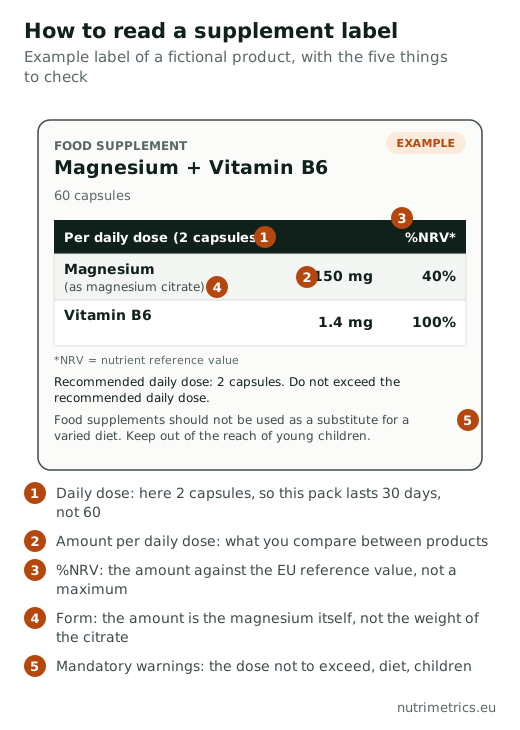
Step 1: find the daily dose, not the capsule
Many products need 2, 3 or even 6 capsules to reach the amount shown in large print. Check how many units make the “daily dose” and divide the pack by that number: a 120-capsule tub with a 3-capsule dose lasts 40 days, not 120.
Step 2: read the mineral, not the compound
For minerals, what counts is the elemental amount. “1,000 mg magnesium bisglycinate” usually provides about 140 mg of magnesium. The table must show the magnesium; if the front of the pack highlights the weight of the compound, ignore the big number. More in our guide to magnesium forms.
Step 3: understand %NRV
The nutrient reference value (NRV) is a labelling reference figure, not a maximum or a personal recommendation. It is the same on UK and EU labels. Some examples from Regulation 1169/2011:
| Nutrient | NRV (100%) | NHS: from supplements, per day | EFSA upper level for adults |
|---|---|---|---|
| Vitamin D | 5 µg | No more than 100 µg | 100 µg a day |
| Vitamin B6 | 1.4 mg | No more than 10 mg | 12 mg a day |
| Zinc | 10 mg | No more than 25 mg | 25 mg a day |
| Magnesium | 375 mg | 400 mg or less | 250 mg a day from supplements |
| Iron | 14 mg | 17 mg or less | No upper level; safe level 40 mg a day |
| Vitamin C | 80 mg | Less than 1,000 mg | No upper level set |
Look at magnesium: 100% of the NRV (375 mg) is below the NHS figure of 400 mg but already exceeds the 250 mg EFSA considers the upper level from supplements. And iron: a 100% NRV tablet (14 mg) is fine by NHS standards, but many iron products sold for anaemia contain more, which is for a GP to decide. A high %NRV is not a quality mark; sometimes it is a reason to read more carefully.
Step 4: spot the common tricks
- Doses that rise if you follow the label’s maximum. From our database (Spanish market): Berocca Energía recommends 1 tablet a day but the label allows 2. At 2 tablets, vitamin B6 reaches 16.4 mg, above EFSA’s upper level of 12 mg and the NHS figure of 10 mg.
- “Blends” without amounts. UK and EU law require the amount of each substance with a nutritional or physiological effect. If only a “proprietary blend” total is shown, you cannot know how much of each you get.
- Unstandardised extracts. For herbs, look for the extract type and concentration (for example “5% withanolides” for ashwagandha). Without it, “500 mg extract” says little.
- Front-of-pack numbers that don’t match the table. The table always wins.
- Banned in one market, allowed in the other. The white colour titanium dioxide (E171), used to coat tablets, has been banned in the EU since August 2022 but is still authorised in Great Britain. If you prefer to avoid it, check the ingredients list.
Step 5: check the promises
A supplement may only use authorised health claims, in their wording and above the minimum dose. The law also forbids attributing to it the property of preventing, treating or curing a disease; in the UK, a product that does is treated as a medicine by the MHRA. “Goodbye insomnia”, “detox” or “boosts your defences against viruses” are signs a label goes beyond what is allowed. In the UK, the word “probiotic” on its own also counts as a health claim.
To check that a product is legally on the market: in the UK there is no public product list, because food supplements need no authorisation or notification before sale; enforcement is done by local Trading Standards and environmental health officers. In Spain, AESAN has a public search of notified supplements; in Germany, supplements must be notified to the federal food safety office (BVL). Notification is not an approval and does not prove that a product works.
Our goal finder shows, for each product we have checked so far (Spain and Germany; UK products are next), the real dose per day and whether it reaches the amount considered effective.
FAQ
What does NRV mean on a supplement?
NRV stands for nutrient reference value, set in Regulation No 1169/2011, which applies in the UK and the EU. The %NRV shows what share of that value the daily dose provides. For example, 375 mg of magnesium is 100% of the NRV.
Is more than 100% NRV bad?
Not necessarily. The NRV is not a maximum. What matters is not exceeding the upper limit: in the UK, the NHS figure for supplements; in the EU, EFSA's tolerable upper level, counting food and supplements. For some nutrients, such as vitamin B6 or zinc, it is easy to go over.
What must a UK or EU food supplement label include?
The name "food supplement", the nutrients or substances it contains and their amount per daily dose, the recommended daily dose, a warning not to exceed it, a statement that it should not replace a varied diet and that it should be kept out of reach of young children, plus the general information required for any food. In Great Britain the business address must be in the UK; in Northern Ireland and the EU, in Northern Ireland or the EU.
What does "elemental" mean on a mineral supplement?
The amount of the pure mineral within the compound. 1,000 mg of magnesium bisglycinate provides about 140 mg of magnesium. The nutrition table must state the mineral, not only the compound.
How can I check that a supplement is legally on the market?
In the UK there is no product register to check: food supplements need no authorisation or notification before sale, although the business must be registered with its local authority. In Spain, AESAN runs a public search of notified food supplements. In Germany, supplements must be notified to the federal food safety office (BVL). Notification is not an approval and does not prove a product works.
Sources
- The Food Supplements (England) Regulations 2003 (labelling, regulation 6)
- GOV.UK — Food labelling: giving food information to consumers (UK address)
- NHS — Vitamins and minerals
- DHSC — Great Britain nutrition and health claims (NHC) register
- COT — Food supplements need no authorisation (background paper)
- Directive 2002/46/EC on food supplements (labelling, Articles 6 and 8)
- Regulation (EU) No 1169/2011 on food information to consumers (Annex XIII, nutrient reference values)
- AESAN — Food supplements (rules and search of notified products, Spanish)
- EFSA — Summary of tolerable upper intake levels for vitamins and minerals (2024)
- European Commission — EU Register of nutrition and health claims