
Key takeaways
- Compare elemental magnesium per daily dose, not the weight of the compound: 1,000 mg of magnesium bisglycinate gives roughly 140 mg of magnesium.
- According to the US NIH, forms that dissolve well (citrate, chloride, lactate) are absorbed better than oxide. There is little head-to-head data for bisglycinate.
- The NHS says 400 mg or less a day of magnesium from supplements is unlikely to cause harm. EFSA's safe upper level for supplements is stricter: 250 mg a day for adults.
- Authorised claims in the UK and EU cover tiredness and fatigue, muscle and nerve function. There is no authorised claim for sleep.
The short answer
There is no single best magnesium. For most adults, a citrate or bisglycinate supplying 100–250 mg of elemental magnesium a day is a reasonable choice: both are absorbed better than oxide and are usually well tolerated. Oxide is the cheapest per tablet but is less well absorbed. “Brain” forms such as L-threonate contain very little magnesium per capsule and have little human evidence.
Before you compare prices, find two numbers on the label: mg of elemental magnesium per daily dose and how many daily doses are in the pack.
How much real magnesium each form contains
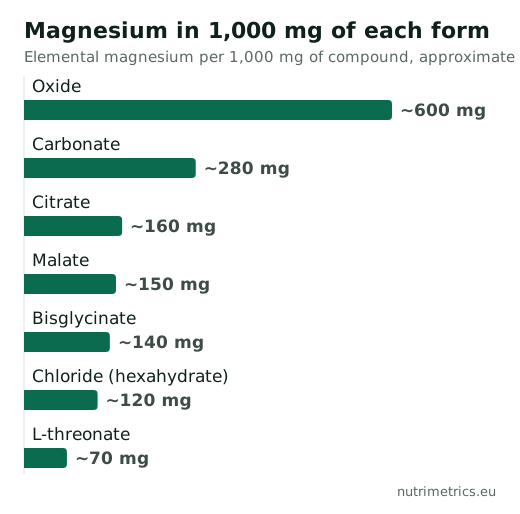
Magnesium is always sold bound to another molecule, and that partner decides how much of each capsule is actually magnesium. A tub of “1,000 mg magnesium bisglycinate” can contain less magnesium than one labelled “400 mg magnesium citrate”.
| Form | Elemental magnesium (approx.) | Compound needed for 200 mg magnesium | Usually chosen for |
|---|---|---|---|
| Oxide | ~60% | ~330 mg | Lowest price per tablet |
| Carbonate | ~28% | ~710 mg | Cheap, often in effervescent tablets |
| Citrate | ~16% | ~1,250 mg | Good absorption at a mid price |
| Malate | ~15% | ~1,330 mg | Alternative to citrate |
| Bisglycinate | ~14% | ~1,430 mg | Gentle on the stomach |
| Chloride (hexahydrate) | ~12% | ~1,670 mg | Common in powders and liquids |
| L-threonate | ~7% | ~2,860 mg | Marketed for memory; little evidence |
Percentages are calculated from each salt’s molecular weight and vary with hydration. The label figure always wins.
Which form is absorbed best
The clearest official summary is the NIH Office of Dietary Supplements fact sheet: forms that dissolve well in liquid are absorbed more completely. Small studies found aspartate, citrate, lactate and chloride more bioavailable than oxide and sulfate.
Bisglycinate is not part of that comparison. It is widely described as well absorbed and well tolerated, but there is little direct evidence comparing it with citrate.
Better absorption does not automatically mean a better outcome. If your diet includes nuts, legumes, whole grains and leafy greens, you may not need a supplement at all.
What magnesium can claim in the UK and EU
In the UK and the EU, a supplement can only make health claims listed in the official register (the Great Britain register in England, Scotland and Wales; the EU register in Northern Ireland and the EU), in the authorised wording. For magnesium the two registers are identical. For magnesium the main ones are that it contributes to:
- the reduction of tiredness and fatigue;
- normal muscle function and normal functioning of the nervous system;
- normal psychological function;
- normal energy-yielding metabolism;
- the maintenance of normal bones and teeth.
A product must supply at least 15% of the reference intake (56 mg of magnesium per daily dose) to use them. There is no authorised claim for sleep, anxiety, cramps or migraine. Packs that promise those are going beyond what the law allows.
Maximum doses
Neither the UK nor the EU has set a binding maximum for magnesium in supplements, so the limits differ by authority:
| Authority | Limit for magnesium from supplements | Status |
|---|---|---|
| NHS (UK) | 400 mg/day or less unlikely to cause harm | Official advice (Department of Health) |
| EFSA (EU) | 250 mg/day for adults | Scientific safe upper level |
| BfR (Germany) | 250 mg/day, split into at least two doses | Recommendation |
| Spain | No national maximum | EU rules apply |
| NIH (United States) | 350 mg/day | US figure, not used in the UK or EU |
The effect behind these limits is diarrhoea: the NHS notes that more than 400 mg for a short time can cause it. According to the NIH, carbonate, chloride and oxide are the forms most often linked to it. Our guide to supplement maximum levels covers other nutrients in the UK and country by country.
One product in our database shows why this matters: natural elements Magnesium Bisglycinat, sold in Germany, lists 300 mg of magnesium in 3 capsules. That is within the NHS figure of 400 mg but above the EFSA and BfR level of 250 mg. It is not illegal, and taking 2 capsules brings it to 200 mg.
Talk to your GP or pharmacist before taking magnesium if you have kidney disease, or take bisphosphonates, tetracycline or quinolone antibiotics, diuretics, or proton pump inhibitors long term.
Which one to choose
| Situation | Form usually chosen | Why |
|---|---|---|
| Sensitive stomach | Bisglycinate | Usually well tolerated at moderate doses |
| Tight budget | Citrate | Good absorption for less money than bisglycinate |
| Lowest price per tablet | Oxide | Most magnesium per tablet, but absorbed less well |
| Powder or liquid | Citrate or chloride | Dissolve well |
How to compare prices properly
Divide the pack price by the number of daily doses, then by the mg of magnesium in each dose:
pack price ÷ daily doses per pack ÷ mg magnesium per dose × 100 = cost per 100 mg
For the example above: €23.99 ÷ 60 daily doses = €0.40 a day for 300 mg, or about €0.13 per 100 mg of magnesium (indicative German price at shop-apotheke.com, checked 15 October 2026). The same formula works in pounds. This lets you compare a 60-tablet pack with a 180-capsule tub on equal terms.
Our goal finder applies the same calculation to the products we have checked so far, for Spain and Germany; UK products are next.
FAQ
What does "elemental magnesium" mean?
It is the amount of pure magnesium inside the compound. UK and EU supplement labels must state the amount of each nutrient per recommended daily dose, so that is the number to compare between products.
Are magnesium glycinate and bisglycinate the same?
In practice, yes. Bisglycinate describes one magnesium atom bound to two glycine molecules, which is what is usually sold as magnesium glycinate. It is roughly 14% elemental magnesium.
How much magnesium can I take a day?
The NHS says adults need about 300 mg (men) or 270 mg (women) a day, mostly from food, and that 400 mg or less a day from supplements is unlikely to cause harm. EFSA sets a stricter tolerable upper level of 250 mg a day from supplements, not counting food, and Germany's BfR advises the same 250 mg split into at least two doses.
Does magnesium help you sleep?
There is no authorised sleep claim for magnesium in the UK or the EU. A 2021 systematic review in older adults found a small reduction in the time taken to fall asleep, based on low-quality evidence.
Can I take magnesium with medication?
Ask your GP or pharmacist first. According to the NIH, magnesium reduces the absorption of bisphosphonates and of tetracycline and quinolone antibiotics, so doses need to be spaced apart.
Sources
- NHS — Others (magnesium)
- DHSC — Great Britain nutrition and health claims (NHC) register
- European Commission — EU Register of nutrition and health claims
- Commission Regulation (EU) No 432/2012 — list of permitted health claims
- EFSA — Dietary reference values and tolerable upper intake levels
- NIH Office of Dietary Supplements — Magnesium fact sheet for health professionals
- BfR — Recommended maximum daily amount of magnesium in food supplements (2017)
- Mah J, Pitre T. Oral magnesium supplementation for insomnia in older adults: a systematic review and meta-analysis. BMC Complement Med Ther, 2021