
Key takeaways
- A handful of pumpkin seeds (30 g) gives about 178 mg of magnesium, 47% of the NRV. A handful and a half matches a 250 mg tablet.
- The NHS puts adult needs at 300 mg a day for men and 270 mg for women; EFSA's adequate intake is a little higher (350 and 300 mg), counting everything you eat and drink.
- Seeds, nuts, oats and cocoa meet the UK and EU threshold for "high in" magnesium. Cooked chickpeas and lentils don't even reach "source of", although a serving gives 54–72 mg.
- Upper limits (250 mg a day for EFSA, 400 mg for the NHS) apply only to magnesium from supplements (and for EFSA water and fortified foods), not to the magnesium naturally in food.
The short answer
Most healthy adults can cover their magnesium with food. According to the NIH, pulses, nuts, seeds, whole grains and leafy greens such as spinach are good sources. A handful of pumpkin seeds and a plate of Spanish spinach with chickpeas already add up to about 350 mg, more than the NHS figure for men (300 mg) and the amount EFSA considers adequate. A supplement makes sense if your GP finds a deficiency, not as daily insurance.
How much magnesium you need
| Figure | Value | What it means |
|---|---|---|
| NHS daily need (UK) | 300 mg/day (men), 270 mg/day (women) | What adults aged 19 to 64 need from food |
| EFSA adequate intake | 350 mg/day (men), 300 mg/day (women) | What food and drink together should add up to |
| NRV on labels | 375 mg | The UK and EU reference used for ”% NRV” |
| NHS figure for supplements | 400 mg/day or less | Unlikely to cause harm |
| EFSA upper limit for supplements | 250 mg/day | Counts only magnesium from supplements, water and fortified foods |
How much each serving gives you
The table is sorted by magnesium per serving, not per 100 g, because that is what you actually eat. “Servings for 250 mg” shows how many servings match one tablet at the amount EFSA considers safe from supplements (the NHS figure is 400 mg). The last column shows whether the food meets the UK and EU threshold to be advertised as a “source of” magnesium (15% of the NRV per 100 g) or “high in” magnesium (30%).
| Food | Serving | Magnesium (mg) | % NRV | Servings for 250 mg | UK/EU threshold (per 100 g) |
|---|---|---|---|---|---|
| Pumpkin seeds, hulled | a handful (30 g) | 178 | 47% | 1.4 | high |
| Spinach, cooked | 150 g | 130 | 35% | 1.9 | source |
| Sunflower seeds, hulled | a handful (30 g) | 98 | 26% | 2.6 | high |
| Quinoa, cooked | 150 g | 96 | 26% | 2.6 | source |
| White beans, cooked | 150 g | 94 | 25% | 2.6 | source |
| Cashews | a handful (30 g) | 88 | 23% | 2.9 | high |
| Almonds | a handful (30 g) | 81 | 22% | 3.1 | high |
| Chickpeas, cooked | 150 g | 72 | 19% | 3.5 | — |
| Rolled oats | 50 g | 69 | 18% | 3.6 | high |
| Brown rice, cooked | 150 g | 58 | 16% | 4.3 | — |
| Tofu, firm | 100 g | 58 | 15% | 4.3 | source |
| Lentils, cooked | 150 g | 54 | 14% | 4.6 | — |
| Peanuts | a handful (30 g) | 50 | 13% | 5.0 | high |
| Dark chocolate 70–85% | 2 squares (20 g) | 46 | 12% | 5.5 | high |
| Wholemeal bread | 2 slices (60 g) | 45 | 12% | 5.6 | source |
| Banana | 1 medium (120 g) | 32 | 9% | 7.7 | — |
| Whole milk | 1 glass (250 ml) | 25 | 7% | 10.0 | — |
| Plain yogurt | 1 pot (125 g) | 15 | 4% | 16.7 | — |
What the table shows:
- Seeds and nuts give the most per bite. Half a handful of pumpkin seeds gives more than a yogurt, a glass of milk and a banana together.
- Cooked pulses are less concentrated because they absorb water, but the large serving makes up for it: 150 g of white beans gives about 94 mg.
- Chickpeas and lentils don’t reach the “source of” threshold, although a serving gives 54–72 mg. The threshold is measured per 100 g, not per serving.
- Dairy and fruit give little magnesium; they are not the foods to build on.
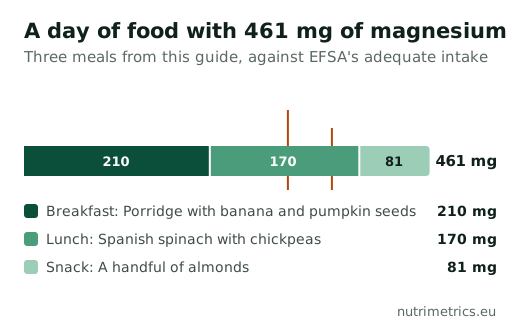
A day with more than 450 mg, without pills
| Meal | What | Magnesium |
|---|---|---|
| Breakfast | Porridge with banana and pumpkin seeds (recipe below) | 210 mg |
| Lunch | Spanish spinach with chickpeas (recipe below) | 170 mg |
| Snack | A handful of almonds (30 g) | 81 mg |
| Total | 461 mg |
You don’t need to eat like this every day. The example shows that three simple steps take you past the adequate intake without getting near any limit, because EFSA’s upper limit does not apply to the magnesium naturally in food.
Water counts too
In the UK and the EU, a natural mineral water may only say that it contains magnesium if it has more than 50 mg per litre. The amount varies a lot between brands, so check the label: a water with 100 mg/l gives you 150 mg if you drink a litre and a half a day. That is magnesium no food table shows.
Two recipes with the numbers
One comes from our Spanish edition, one from our German edition.
Spanish spinach with chickpeas (espinacas con garbanzos, 4 servings)
Ingredients: 500 g cooked chickpeas (drained), 500 g fresh spinach, 60 g wholemeal bread, 3 garlic cloves, 4 tbsp extra virgin olive oil, 1 tsp ground cumin, 1 tsp sweet paprika, 1 tbsp sherry vinegar and salt.
- Wilt the spinach in a wide pan with a splash of oil. Set aside.
- Fry the torn bread and sliced garlic in the rest of the oil until golden.
- Pound them in a mortar with the cumin, paprika, vinegar and a little water to a paste.
- Put the chickpeas, spinach and paste in the pan, add a glass of water and simmer gently for 10 minutes.
Per serving: about 170 mg magnesium (45% of the NRV) and 7.4 mg iron (53%).
Porridge with banana and pumpkin seeds (1 serving)
Ingredients: 50 g rolled oats, 250 ml milk, 1 small banana (100 g), 15 g hulled pumpkin seeds and cinnamon.
- Simmer the oats in the milk over a medium heat, stirring, for about 5 minutes.
- Top with sliced banana, pumpkin seeds and cinnamon.
Per serving: about 210 mg magnesium (56% of the NRV).
When food isn’t enough
- If your GP finds a low level, they may recommend a supplement. To choose the form and dose, see magnesium forms compared and our magnesium page.
- If you have kidney disease, don’t take magnesium supplements without medical advice.
- If you’re looking at it for sleep, read magnesium for sleep first: there is no authorised claim about sleep in the UK or the EU.
This guide is part of the series The best supplement is on your plate.
How we calculated the numbers
Values per 100 g come from the USDA’s FoodData Central database (SR Legacy), which systematically covers cooked foods, checked against Spain’s BEDCA database. NutriMetrics calculates the servings, percentages and equivalents. The % NRV uses the 375 mg reference from Regulation 1169/2011, which applies in the UK and the EU. UK daily needs come from the NHS. Real amounts vary with the variety, origin and cooking method.
FAQ
How much magnesium do I need a day?
The NHS says about 300 mg a day for men and 270 mg for women aged 19 to 64; EFSA sets 350 and 300 mg. Labels show the reference value (NRV) of 375 mg, which is used to calculate percentages but is not your personal need.
Can I get too much magnesium from food?
No. Upper limits apply to magnesium from supplements (EFSA: 250 mg a day, also counting water and fortified foods; NHS: 400 mg), not to the magnesium naturally in food. With supplements, loose stools are common above those amounts.
Does mineral water count?
Yes. In the UK and the EU, a natural mineral water may say it contains magnesium if it has more than 50 mg per litre. Check the label: a water with 100 mg/l gives you 150 mg in a litre and a half.
Why is cooked spinach so high on the list?
Because a serving of vegetables is heavy (150 g) and spinach loses water when cooked. Per 100 g it gives less than seeds, but a normal serving adds up to about 130 mg.
When does a magnesium supplement make sense?
When your GP finds a low level, or if your diet falls short and you can't change it. If you have kidney disease, don't take magnesium without medical advice, because the kidneys remove the excess.
Sources
- NHS — Others (magnesium, selenium, zinc)
- USDA FoodData Central — SR Legacy (food composition per 100 g)
- AESAN — Spanish food composition database (BEDCA)
- EFSA (2015) — Dietary reference values for magnesium
- EFSA — Overview of tolerable upper intake levels (2024)
- NIH Office of Dietary Supplements — Magnesium, fact sheet for consumers
- Regulation (EU) No 1169/2011, Annex XIII — reference intakes (NRV) and significant amount
- European Commission — Nutrition claims ("source of", "high")
- Directive 2009/54/EC on natural mineral waters, Annex III