
Key takeaways
- Neither collagen nor hyaluronic acid has an authorised health claim in the UK or the EU. EFSA rejected the joint-health claim for collagen hydrolysate in 2012, and Great Britain kept that decision.
- A 2025 meta-analysis of 23 trials found no clinical evidence that collagen slows skin ageing: benefits appeared only in industry-funded studies.
- The added magnesium is what allows a legal claim (bones, muscles, tiredness). Keep total magnesium from supplements under 250 mg a day.
- Oral hyaluronic acid has some positive trials on skin hydration, but they are few and small.
The short answer
Collagen with magnesium and collagen with hyaluronic acid are popular across Europe and best-sellers in Spain, but neither headline ingredient has an authorised health claim, on either the Great Britain or the EU register. What the pack may legally promise comes from the magnesium (bones, muscles, tiredness) or from vitamin C when it is added (collagen formation). The evidence for collagen on skin is disputed, and for oral hyaluronic acid it is thin. If you buy these, you are mainly paying for the magnesium and taking a bet on the rest.
What each product may claim
| Product | Ingredient with an authorised claim | What the pack may say |
|---|---|---|
| Collagen with magnesium | Magnesium | Contributes to the maintenance of normal bones, normal muscle function and the reduction of tiredness and fatigue |
| Collagen with hyaluronic acid | None, unless vitamins or minerals are added | Nothing about skin or joints, except what added vitamin C or another nutrient allows |
| Collagen with vitamin C | Vitamin C | Contributes to normal collagen formation for the normal function of skin, cartilage and bones |
EFSA assessed a joint-health claim for collagen hydrolysate and found that a cause-and-effect relationship had not been established; the EU refused it in 2012, before Brexit, so the refusal also stands on the Great Britain register. That is why so many collagen products add magnesium or vitamin C. See our table of approved health claims.
What the evidence shows
| Ingredient | Key study | Result |
|---|---|---|
| Collagen (skin) | 2025 meta-analysis, 23 trials, 1,474 participants | Pooled results suggested better hydration and elasticity, but only in industry-funded studies. Independent and higher-quality trials found no effect. Industry groups dispute the analysis |
| Oral hyaluronic acid (skin) | 2025 meta-analysis, 7 trials | Improvements in hydration, elasticity and wrinkle depth, in few, small and varied studies |
| Collagen (joints) | Trials with 5–10 g a day | Mixed results; possible small benefit |
The honest conclusion: collagen for skin is currently a disputed bet. Critics of the meta-analysis have a point — “collagen” covers very different ingredients and doses — but when only manufacturer-funded studies come out positive, caution is warranted.
The detail almost nobody checks: the dose
Many tablet products contain only a few grams of collagen per daily dose, while studies typically use 2.5–10 g. An example from our database: Ana María Lajusticia Colágeno con magnesio tablets list 6 tablets a day for 3.6 g of collagen and 169 mg of magnesium (label checked on 4 November 2026; 9 tablets give 5.4 g and 254 mg).
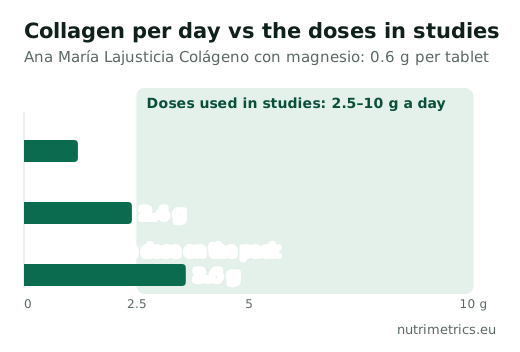
Two practical consequences:
- Take fewer tablets than listed and you get very little collagen.
- Take another magnesium supplement too and you need to add them up. EFSA sets the upper level for magnesium from supplements at 250 mg a day; 169 mg from this product leaves only 81 mg of headroom. The NHS figure is higher (400 mg or less a day from supplements is unlikely to cause harm), but above these amounts diarrhoea becomes more likely.
So which makes sense?
| If what you want is… | Most sensible choice |
|---|---|
| Magnesium, with collagen as an extra | Collagen with magnesium, counting your total daily magnesium |
| Better-hydrated skin | Neither has an authorised claim. Oral hyaluronic acid has some evidence; collagen’s is disputed |
| Joint support | Weak evidence for collagen. See your GP if pain persists |
| Best value | Compare cost per gram of collagen and per mg of magnesium, not the tub price |
Our guides to magnesium forms and magnesium for sleep explain what magnesium does and how much to take.
Talk to your GP or pharmacist before taking magnesium if you have kidney disease, or take antibiotics, bisphosphonates or proton pump inhibitors long term.
FAQ
What can collagen with magnesium legally claim?
Only what the magnesium contributes: the maintenance of normal bones, normal muscle function and the reduction of tiredness and fatigue. Collagen itself has no authorised claim.
Is collagen with hyaluronic acid better for skin?
Oral hyaluronic acid has a few trials showing better skin hydration, but they are small and there is no authorised claim. Authorised skin claims exist only for certain vitamins and minerals, such as vitamin C (collagen formation), zinc and biotin.
How much collagen should I take?
Studies typically use 2.5–10 g of hydrolysed collagen a day. Check how many grams your product's daily dose actually provides: many tablets contain much less.
Is there vegan collagen?
No. Collagen always comes from animals (cattle, pigs, fish). "Vegan collagen" products contain amino acids or vitamins the body uses to make its own collagen, not collagen itself.
Why do so many collagen products contain vitamin C?
Vitamin C has an authorised claim: it contributes to normal collagen formation for the normal function of skin, cartilage and bones. Adding it lets the product carry a legal claim that collagen alone cannot.
Sources
- DHSC — Great Britain nutrition and health claims (NHC) register
- NHS — Others (magnesium, selenium, zinc)
- Myung SK, Park Y. Effects of collagen supplements on skin aging: a systematic review and meta-analysis of randomized controlled trials. Am J Med, 2025 (summary and industry response in NutraIngredients)
- Commission Regulation (EU) No 379/2012 — refusal of health claims, including collagen hydrolysate
- Oral hyaluronic acid supplement: efficacy in skin hydration, elasticity and wrinkle depth reduction (meta-analysis). J Drugs Dermatol, 2025
- European Commission — EU Register of nutrition and health claims
- EFSA — Dietary reference values and tolerable upper intake levels