
Key takeaways
- Vitamin D does not need K2 to work. The NHS advises vitamin D on its own (10 µg a day in autumn and winter), and there is no authorised claim for the combination in the UK or the EU.
- Germany's BfR recommends a maximum of 25 µg of vitamin K2 per daily dose in supplements, and 20 µg of vitamin D.
- K2 is about 3.5 times as potent as K1 at weakening coumarin-type blood thinners such as warfarin. If you take one, do not add K2 without talking to your GP or anticoagulation clinic.
- The BfR advises against high vitamin D doses taken every few days or weeks, including in combination with K2.
The short answer
You don’t need K2 for vitamin D to work. The NHS advice is a plain 10 µg vitamin D supplement in autumn and winter; neither UK nor other European authorities recommend adding K2, and no health claim for the combination is authorised in the UK or the EU. A small dose of K2 (up to 25 µg a day) does not appear harmful for most people, but it has no proven benefit. What does matter: if you take blood thinners such as warfarin, don’t add K2 without your GP or anticoagulation clinic, and avoid mega-doses of vitamin D taken every few days.
What official bodies say
| Source | What it says |
|---|---|
| NHS (UK) | Everyone should consider 10 µg of vitamin D a day in autumn and winter; adults should not take more than 100 µg a day. No advice to add K2 |
| BfR (Germany, 2024 and 2025) | Recommended maximum of 25 µg K2 and 20 µg vitamin D per daily dose in supplements. High-dose D + K2 combinations have hardly been studied |
| BfR (2025) | High vitamin D doses taken every few days or weeks raise the risk of dosing errors and are linked to more falls and fractures in some studies. A low daily dose is preferable |
| Verbraucherzentrale (Germany, 2026) | Vitamin D alone is enough. Adding K2 is harmless but has no proven benefit |
| German osteoporosis guideline (2023) | K2 should not be used as a specific treatment for osteoporosis |
| EFSA | Adequate intake for vitamin K: 70 µg a day for adults, normally covered by food |
What the law allows on the label
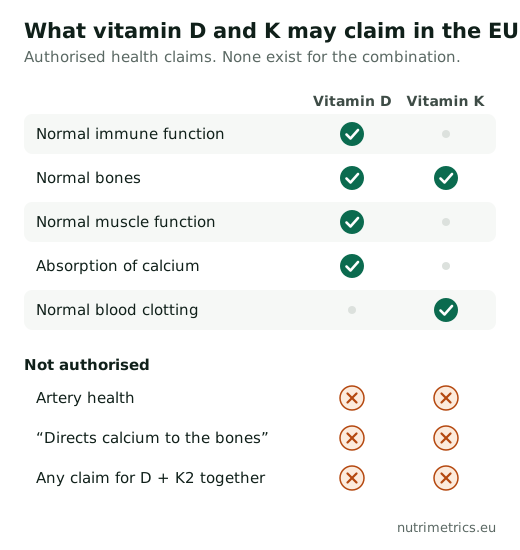
On both the Great Britain and the EU registers, vitamin K has two authorised claims: it contributes to normal blood clotting and to the maintenance of normal bones. Vitamin D has its own (immune system, bones, muscles, calcium absorption). There are none for the combination, for “directing calcium to the bones” or for artery health. See our table of approved health claims.
What about arteries?
The sales argument is that K2 activates a protein that stops calcium being deposited in arteries. The evidence is preliminary: a 2023 meta-analysis of 14 trials found slightly slower coronary calcification in 4 trials with 424 people, mostly with kidney disease or other conditions. Results for other arteries were mostly negative, and the authors call for better-designed trials. There is no evidence that healthy people taking normal vitamin D doses need K2.
Careful with blood thinners
According to the BfR, K2 is about 3.5 times as potent as K1 at weakening vitamin K antagonist drugs such as warfarin, phenprocoumon (Marcumar) or acenocoumarol (Sintrom). Sudden changes in vitamin K intake are a serious risk for these patients, which is why the BfR recommends a warning on supplements containing vitamin K. If you take one of these drugs, talk to your GP or anticoagulation clinic before taking K2. In the UK, warfarin is the vitamin K antagonist in common use.
An example from our database
Vita Natura Vitamin D3+K2 drops, sold in Germany, provide 25 µg (1,000 IU) of vitamin D and 20 µg of K2 (MK-7) per drop. The K2 is within the BfR maximum; the vitamin D is slightly above it (25 vs 20 µg) but far below the 100 µg maximum used by both the NHS and EFSA. Always compare µg per drop or capsule, not per millilitre.
How to choose
- Vitamin D alone is enough for most people. Our guide to vitamin D in winter explains the NHS advice and how much to take.
- If you prefer D3 + K2, pick a product with 25 µg of K2 or less per daily dose.
- Small daily doses beat weekly or monthly mega-doses, unless prescribed.
- No K2 on blood thinners without medical advice.
Our goal finder lists the vitamin D and K2 products we have checked so far, for Spain and Germany; UK products are next.
FAQ
Should vitamin D be taken with K2?
It is not necessary. The NHS advises a plain vitamin D supplement, and no official UK or European body recommends combining them, and Germany's osteoporosis guideline says K2 should not be used as a specific treatment for osteoporosis.
Does K2 stop calcium building up in arteries?
Not proven. A 2023 meta-analysis found slightly slower coronary calcification in 4 trials with 424 people, mostly with kidney disease or other conditions. The authors call for more research, and there is no authorised claim for arteries.
How much vitamin K2 is safe?
The BfR recommends no more than 25 µg of K2 per daily dose in supplements for people aged 15 and over. EFSA's adequate intake for vitamin K is 70 µg a day for adults, normally covered by food.
Can I take K2 with warfarin?
Only under medical supervision. Vitamin K reduces the effect of vitamin K antagonists such as warfarin, phenprocoumon or acenocoumarol, and sudden changes in vitamin K intake are a serious risk.
MK-7 or MK-4?
Most supplements use MK-7. For consumers, what matters is the amount in µg per dose and staying within the 25 µg a day the BfR recommends.
Sources
- NHS — Vitamin D
- DHSC — Great Britain nutrition and health claims (NHC) register
- BfR — High single doses of vitamin D taken at intervals of days or weeks carry health risks (Opinion 031/2025)
- Verbraucherzentrale — Is vitamin D better with vitamin K2? (2026, German)
- Verbraucherzentrale — Vitamin K products: what makes sense? (2025, German)
- Li T et al. Vitamin K supplementation and vascular calcification: a systematic review and meta-analysis of randomized controlled trials. Front Nutr, 2023
- EFSA — Dietary reference values for vitamin K (2017)
- European Commission — EU Register of nutrition and health claims