
Key takeaways
- UK and EU law allow creatine to claim that it increases physical performance in successive bursts of short-term, high-intensity exercise, at 3 g of creatine a day. A claim for brain function was rejected in Great Britain in 2024.
- Creatine monohydrate is about 88% creatine, so reaching 3 g of creatine takes about 3.4 g of monohydrate.
- Loading is optional: 3–5 g a day saturates your muscles in about four weeks.
- Early weight gain is mostly water inside the muscle. The hair-loss worry comes from a single 2009 study that has never been replicated.
The short answer
If you do strength training, sports with short intense efforts (sprints, football, rugby, padel, HIIT), or you are over 55 and lift weights, creatine monohydrate is the supplement with the most evidence behind it. Take 3–5 g a day, every day, with or without a loading phase. Buy monohydrate: it is the most studied and the cheapest form. “Advanced” versions have not been shown to work better.
What creatine is allowed to claim in the UK and EU
Creatine is one of the few sports supplements with authorised health claims. Great Britain kept them after Brexit, so they read the same on the GB and EU registers:
| Authorised claim | For whom | Condition |
|---|---|---|
| Creatine increases physical performance in successive bursts of short-term, high-intensity exercise | Adults doing high-intensity exercise | 3 g of creatine a day |
| Daily creatine consumption can enhance the effect of resistance training on muscle strength | Adults over 55 doing regular resistance training | 3 g a day, with training at least 3 times a week at increasing workload |
The second claim was authorised in 2017 after an EFSA assessment. EFSA found that taking creatine only on training days did not have the same effect: daily intake is what counts. If you are over 55, our guide to creatine after 55 explains every condition of that claim.
Building muscle mass, “burning fat”, memory and hormone health are not authorised claims. For memory and thinking, the question has been tested: in 2024 the UK Nutrition and Health Claims Committee found that the evidence did not show that up to 3 g a day improves cognitive function, and Great Britain listed the claim as non-authorised in 2025. A tub that promises any of these is going beyond what the law allows.
The 3 g detail most labels skip
The authorised claim refers to 3 g of creatine, but monohydrate is not pure creatine. It carries a water molecule and is about 88% creatine. So:
- 3 g of monohydrate gives about 2.6 g of creatine;
- reaching 3 g of creatine takes about 3.4 g of monohydrate;
- the common 5 g serving of monohydrate gives about 4.4 g.
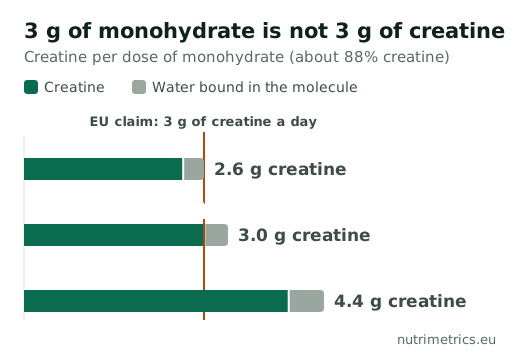
Many products use a 3 g scoop. Myprotein’s unflavoured creatine monohydrate, for example, lists one 3 g scoop a day. It works, but to match the authorised claim exactly, use 3.5–5 g.
How much to take
The International Society of Sports Nutrition (ISSN) 2017 position stand is the reference review:
- No loading: 3–5 g a day. Muscles are saturated in about 4 weeks.
- With loading (optional): about 0.3 g per kg of body weight a day (about 20 g for 70 kg) in four doses for 5–7 days, then 3–5 g a day.
- How: in water, juice or a protein shake. Taking it with a meal containing carbohydrates may help muscle uptake.
Vegetarians and vegans usually have lower muscle creatine, because dietary creatine comes mainly from meat and fish, and tend to respond more strongly in studies.
Monohydrate, Creapure and other forms
| Form | What it is | Verdict from the evidence |
|---|---|---|
| Monohydrate | The standard form used in almost all studies | The benchmark; cheapest per gram |
| Micronised monohydrate | Monohydrate with smaller particles | Mixes better; same effect |
| Creapure | A brand of monohydrate made in Germany by AlzChem | Same compound, with documented purity testing |
| Hydrochloride (HCl) | Creatine bound to hydrochloric acid | Few studies; no proven advantage |
| Kre-Alkalyn (buffered) | Creatine with altered pH | A 2012 trial found no advantage over monohydrate |
Is Creapure worth the premium? It is not more effective; it is the same monohydrate. You pay for a German manufacturer with published quality testing. If you compete in a tested sport, a batch-tested product (for example under the Informed Sport scheme) matters more than the raw material brand. If a generic brand publishes batch purity tests, the difference comes down to price.
Myths and side effects
“It makes you bloated.” In the first days, especially with loading, a gain of around 1–2 kg is common. That is water held inside the muscle, not under the skin. Without loading, the change is gradual.
“It causes hair loss.” This traces to a single 2009 study of 20 rugby players that saw a rise in the hormone DHT. It did not measure hair loss, it has not been replicated, and other studies found no DHT change.
“It damages your kidneys.” No kidney damage has been found in healthy people at normal doses. Creatine does raise blood creatinine, a kidney marker, so mention it before a blood test. If you have kidney disease, do not take it without medical advice.
Stomach upset mostly happens with large single doses. Splitting a loading dose usually avoids it.
Creatine for women
The authorised claim does not distinguish between men and women. There is less research in women, but a 2021 review found similar effects on strength and performance and good tolerance across life stages. Interest in menopause and bone health is growing, but there are no authorised claims for those uses yet.
Talk to your GP if you are pregnant or breastfeeding, or have kidney or liver disease.
How to compare prices
Compare the price per 5 g of monohydrate, not the price of the tub:
tub price ÷ grams in the tub × 5 = cost per 5 g serving (in pounds or euros)
A 250 g tub holds 50 servings of 5 g; a 1 kg tub holds 200. Larger tubs are almost always cheaper per serving, and creatine powder keeps well if stored closed and dry.
Our goal finder lists the creatine products we have checked so far, for Spain and Germany; UK products are next.
FAQ
How much creatine should I take a day?
The authorised claim (the same in the UK and EU) is based on 3 g of creatine a day. The International Society of Sports Nutrition (ISSN) recommends 3–5 g a day for maintenance, with an optional loading phase of about 20 g a day in four doses for 5–7 days.
Should I take creatine before or after training?
Timing matters much less than taking it every day. Performance benefits come from saturated muscle stores, which depend on consistency.
Does creatine damage your kidneys?
No kidney damage has been found in healthy people at normal doses. Creatine does raise creatinine in blood tests, so tell your GP before a test. If you have kidney disease, do not take it without medical advice.
Is Creapure better than other creatine?
It is the same compound, creatine monohydrate, made by AlzChem in Germany. You pay for documented purity and traceability, not for a stronger effect.
Are the creatine claims the same in the UK and the EU?
Yes. Great Britain kept the EU list of authorised claims after Brexit, so the same wording and the same 3 g condition apply in the UK, Spain, Germany and every other EU country. Both have also turned down a claim that creatine improves cognitive function.
Can creatine claim to help memory or brain function?
No. In 2024 the UK Nutrition and Health Claims Committee concluded that the evidence did not show that 3 g of creatine a day improves cognitive function, and the claim was added to the Great Britain register as non-authorised. The EU is rejecting the same claim.
Sources
- DHSC — Great Britain nutrition and health claims (NHC) register
- UKNHCC (2024) — Scientific opinion: creatine supplementation and improved cognitive function
- European Commission — EU Register of nutrition and health claims (creatine)
- Commission Implementing Regulation (EU) 2017/672 — creatine and resistance training in adults over 55
- EFSA (2016) — Creatine in combination with resistance training and improvement in muscle strength
- Kreider RB et al. ISSN position stand: safety and efficacy of creatine supplementation in exercise, sport, and medicine. JISSN, 2017
- Antonio J et al. Common questions and misconceptions about creatine supplementation. JISSN, 2021
- Smith-Ryan AE et al. Creatine supplementation in women's health: a lifespan perspective. Nutrients, 2021
- Jagim AR et al. A buffered form of creatine does not promote greater changes in muscle creatine content, body composition, or training adaptations than creatine monohydrate. JISSN, 2012
- NIH Office of Dietary Supplements — Dietary supplements for exercise and athletic performance