
Key takeaways
- In the UK, ashwagandha is legal as a food supplement, but the Food Standards Agency's Committee on Toxicity has been reviewing its safety since 2024. Meanwhile the FSA advises pregnant women and people with liver conditions to avoid it.
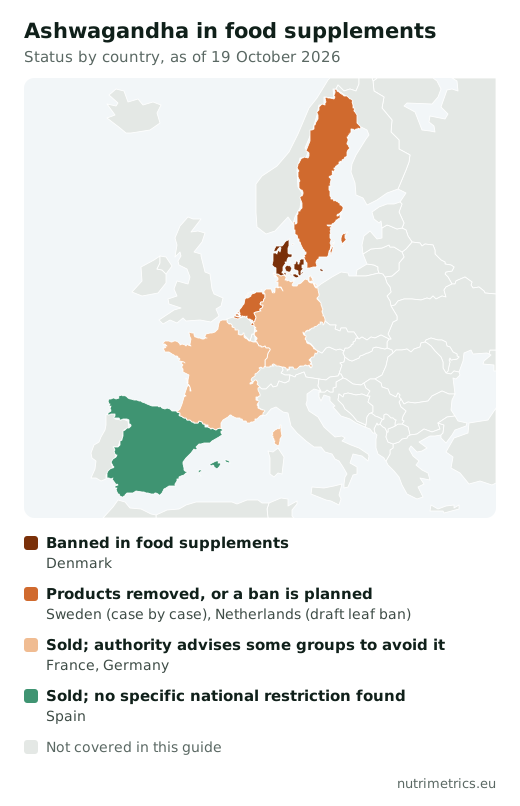
- There is no EU-wide rule on ashwagandha. Denmark banned it in food supplements in 2023; the Netherlands has a draft ban on the leaf, open for comments until 7 December 2026.
- Germany's BfR found that no safe daily amount can be set and advises children, pregnant and breastfeeding women and people with liver disease not to take it.
- Trials show a moderate effect on perceived stress and a small effect on sleep, mostly at around 600 mg of root extract a day for 8 weeks or more.
- There is no authorised health claim for ashwagandha in the UK or the EU. A root-only extract is the most conservative choice.
The short answer
Ashwagandha (Withania somnifera) is legal in the UK and in most of the EU, but under scrutiny. In the UK, the Food Standards Agency (FSA) is reviewing its safety and already advises pregnant women and people with liver conditions to avoid it. In the EU there is no common rule, so each country decides: Denmark has banned it in food supplements, the Netherlands plans to ban the leaf, and Germany’s risk assessment body advises several groups not to take it. The evidence for stress and sleep is real but modest. If you are pregnant, breastfeeding, have liver or thyroid problems, or take medication, talk to your GP first.
Status by country
| Country | Status | What the rule says | Source |
|---|---|---|---|
| Denmark | Banned | Banned in food supplements since 2023: the Danish authorities could not establish a safe dose. | NutraIngredients — Timeline of regulatory action on ashwagandha in Europe (July 2026) |
| Netherlands | Ban planned | RIVM advises against using it (2024). A draft decree would ban ashwagandha in supplements and herbal preparations except the root, and require warnings on root products (pregnancy, breastfeeding, liver and thyroid problems). The EU standstill period ends on 7 December 2026. | RIVM — Risk assessment of herbal preparations containing Withania somnifera (2024) NutraIngredients — Ashwagandha targeted under proposed Dutch supplement rules (October 2026) SupplySide — Ashwagandha regulation around the world: FAQ (October 2026) |
| Sweden | Restricted | Several high-dose products have been removed from the market, decided case by case (reported in 2023). | NutraIngredients — Timeline of regulatory action on ashwagandha in Europe (July 2026) Checked: 30 Oct 2026 |
| Poland | Restrictedmax. 10 mg withanolides/day | Allowed with limits (2020 resolution): less than 3 g of root powder and at most 10 mg of withanolides a day; labels must state the withanolide content and carry a warning. | SupplySide — Ashwagandha regulation around the world: FAQ (October 2026) |
| France | Allowed, with warnings | Sold legally, with no legal limit. ANSES (2024) advises pregnant and breastfeeding women, children and teenagers and people with some conditions not to take it. | NutraIngredients — French agency warns ashwagandha unsafe in specific populations (June 2024) SupplySide — Ashwagandha regulation around the world: FAQ (October 2026) |
| Germany | Allowed, with warnings | Sold legally. The BfR says no safe daily amount can be derived and advises children, pregnant and breastfeeding women and people with liver disease not to take it (2024). | BfR — Ashwagandha preparations with possible health risks (Communication 039/2024, German) |
| United Kingdom | Allowed, with warnings | Legal as a food supplement. The FSA advises pregnant women and people with liver conditions to avoid it; its Committee on Toxicity is reviewing safety and has not published a final statement yet. | Which? — Ashwagandha: stress buster or health risk? (includes the FSA's advice) UK Parliament — Written question on ashwagandha food supplements (answered 20 April 2026) |
| Spain | Allowed | Sold as a food supplement. We found no specific national restriction or maximum amount. | Regask — Regulatory status of ashwagandha in food supplements in Spain |
| EU level | EU-wide | No harmonised EU rule yet. In June 2024 the heads of national food agencies recommended prioritising ashwagandha for a review under Article 8 of Regulation 1925/2006, which can restrict or ban a substance EU-wide; the procedure had not been opened by autumn 2026. | SupplySide — Ashwagandha regulation around the world: FAQ (October 2026) |
National rules change. Check the date and the source before you rely on a row. Next check: (End of the EU standstill period for the Dutch draft decree); (Next meeting of the UK Committee on Toxicity).
We update the table as rules change, including when the UK statement is published. Inside the EU, mutual recognition means a product lawful in one country can often be sold in another, but a country can block it on health grounds if the measure is justified. Great Britain is outside that system. Our guide to supplement maximum levels in Europe explains how this works.
Why authorities are cautious
In the UK, the FSA asked its Committee on Toxicity (COT) to review ashwagandha because ashwagandha supplements were becoming more popular and the number of incidents notified to the FSA was rising. According to the committee’s 2025 summary, FSA risk assessments of those incidents found associations with thyroid toxicity, low blood sugar and possible liver toxicity. The COT noted that reported effects were inconsistent and that some forms have a long history of use, but said it needs more data on long-term effects, liver toxicity and contaminants before it can set a safe level.
Germany’s BfR published its assessment in September 2024. It concluded that no safe daily amount can be derived from the available data, based on:
- case reports of liver injury, including acute liver failure;
- evidence of effects on the thyroid, sex hormones, cortisol and blood sugar;
- missing safety data in pregnancy and breastfeeding, and a traditional use as an abortifacient;
- possible interactions with antidiabetic, blood-pressure and immunosuppressant drugs.
The Dutch RIVM reached a similar conclusion in 2024: harmful effects can occur in sensitive people, it is unknown who they are, and avoiding it is the precautionary advice.
What the evidence shows
| Use | Finding | Quality |
|---|---|---|
| Perceived stress | A 2021 review of 7 trials (491 adults, 6–8 weeks) found lower stress, anxiety and cortisol than placebo | Small, short trials, all in India |
| Sleep | A 2021 meta-analysis of 5 trials found a small but significant effect, larger at ≥600 mg a day, ≥8 weeks and in people with insomnia | Moderate for overall sleep, low for sleep quality |
| Generalised anxiety | An international expert taskforce gives a provisional recommendation (300–600 mg root extract) and calls for more research | Limited |
According to the NIH, two problems run through the research: extracts differ widely (root vs leaf, withanolide content) and there is almost no safety data beyond three months.
There is no authorised health claim for ashwagandha on the Great Britain or the EU register. Claims for botanicals have been “on hold” for years on both, so “reduces stress” or “improves sleep” on a pack goes beyond what the law allows in the UK and the EU.
How to choose, if you decide to take it
- Root only. The most recent restrictions, in the Netherlands and India, target the leaf. KSM-66 is root-only; Sensoril and Shoden combine root and leaf.
- Study doses. Most trials use 300–600 mg of standardised extract a day. More has not been shown to be better.
- Withanolides stated. A good label states the withanolide percentage (for example 5%).
- Check the manufacturer’s label, not the shop listing. In our database, one retailer listed 500 mg of KSM-66 per capsule, an unusual figure for that extract (normally 300 or 600 mg).
- Set an end date. Use it for a limited period, around 8–12 weeks as in the trials. Stop and see a doctor if you notice dark urine, itching, unusual tiredness or yellowing of the skin or eyes.
Our goal finder compares the evidence for ashwagandha with other options for stress and sleep, such as L-theanine and magnesium.
FAQ
Is ashwagandha banned in the UK?
No. As of October 2026 it is legal as a food supplement in the UK. The FSA asked its Committee on Toxicity to assess its safety after a rising number of incidents linked to ashwagandha supplements; the committee discussed a third draft statement in September 2026, which has not been published. Until then, the FSA advises pregnant women and people with pre-existing liver conditions to avoid it.
Is ashwagandha banned in the EU?
Not at EU level. Denmark banned it in food supplements in 2023, Sweden has removed several high-dose products case by case, and the Netherlands has a draft rule to ban the leaf. It is still sold in Germany and Spain.
Why are European authorities worried about ashwagandha?
Case reports of liver injury, some severe, and signs of effects on the thyroid, sex hormones, cortisol and blood sugar. Germany's BfR concluded in 2024 that no safe daily amount can be derived from current data.
Who should not take ashwagandha?
In the UK, the FSA advises pregnant women and people with pre-existing liver conditions to avoid it. Germany's BfR adds children and breastfeeding women. Ask your doctor first if you take thyroid, diabetes or blood-pressure medicines, immunosuppressants or sedatives.
What is the difference between KSM-66 and Sensoril?
KSM-66 is a root-only extract. Sensoril and Shoden combine root and leaf. Recent restrictions in the Netherlands and India focus on the leaf.
How long can I take ashwagandha?
Most trials last 6 to 12 weeks. According to the NIH it is generally well tolerated for up to about 3 months; long-term safety is unknown.
Sources
- Which? — Ashwagandha: stress buster or health risk? (includes the FSA's advice)
- COT (2025) — Review of the safety of ashwagandha in food, drinks and food supplements (Toxicology Letters abstract)
- COT — Meeting minutes, 21 October 2025 (draft statement on ashwagandha)
- UK Parliament written question on ashwagandha food supplements (answered 20 April 2026)
- NIH Office of Dietary Supplements — Ashwagandha fact sheet for health professionals (2025)
- BfR — Ashwagandha preparations with possible health risks (Communication 039/2024)
- RIVM — Risk assessment of herbal preparations containing Withania somnifera (2024)
- NutraIngredients — Ashwagandha targeted under proposed Dutch supplement rules (October 2026)
- NutraIngredients — Timeline of regulatory action on ashwagandha in Europe (July 2026)
- Cheah KL et al. Effect of ashwagandha extract on sleep: a systematic review and meta-analysis. PLoS ONE, 2021
- European Commission — EU Register of nutrition and health claims