
Key takeaways
- The NHS puts iron needs at 8.7 mg a day for men and women over 50, and 14.8 mg for women aged 19 to 49. EFSA's figures are a little higher: 11 and 16 mg.
- A plate of lentils or white beans (150 g cooked) gives about 5 mg, twice as much as a beef steak. But iron from plants is absorbed less well.
- According to the NIH, the body absorbs 14–18% of the iron from a mixed diet and 5–12% from a vegetarian diet. Vitamin C and a little meat or fish in the same meal help.
- Don't take iron "just in case": get a blood test first. Too much iron also does harm.
The short answer
Most adults can cover their iron with food, but no other nutrient depends so much on how you eat. According to the NIH, the body absorbs 14–18% of the iron from a mixed diet and 5–12% from a vegetarian diet. A lentil stew with raw red pepper gives you more usable iron than the same stew without it. Take a supplement only if a blood test confirms a deficiency.
How much iron you need
| Who | NHS (UK) | EFSA reference intake |
|---|---|---|
| Adult men | 8.7 mg/day | 11 mg/day |
| Women aged 50 and over / after the menopause | 8.7 mg/day | 11 mg/day |
| Women aged 19 to 49 / of childbearing age | 14.8 mg/day | 16 mg/day |
The NHS notes that women who still have periods after 50 may need the same as younger women, and that women with heavy periods are at higher risk of iron deficiency.
The NRV on UK and EU labels is 14 mg. The NIH estimates that people on a vegetarian diet need 1.8 times more iron, because they absorb it less well.
How much each serving gives you
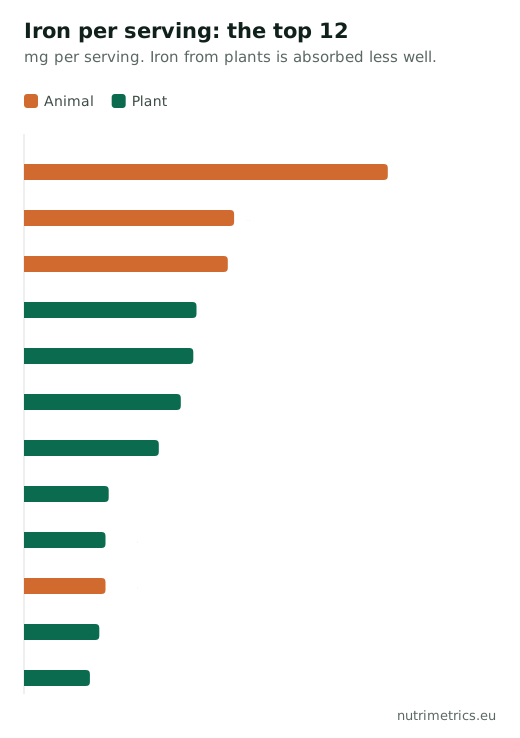
Sorted by iron per serving. The “Origin” column matters: part of the iron in meat, fish and shellfish is haem iron, which is absorbed better; how much plant iron you absorb depends on what you eat with it. The last column shows whether the food meets the UK and EU threshold to be advertised as a “source of” iron (15% of the NRV per 100 g) or “high in” iron (30%).
| Food | Serving | Iron (mg) | % NRV | Origin | UK/EU threshold (per 100 g) |
|---|---|---|---|---|---|
| Chicken liver, cooked | 100 g | 11.6 | 83% | animal | high |
| Mussels, cooked (meat) | 100 g | 6.7 | 48% | animal | high |
| Beef liver, cooked | 100 g | 6.5 | 47% | animal | high |
| White beans, cooked | 150 g | 5.5 | 40% | plant | source |
| Spinach, cooked | 150 g | 5.4 | 38% | plant | source |
| Lentils, cooked | 150 g | 5.0 | 36% | plant | source |
| Chickpeas, cooked | 150 g | 4.3 | 31% | plant | source |
| Tofu, firm | 100 g | 2.7 | 19% | plant | source |
| Pumpkin seeds, hulled | a handful (30 g) | 2.6 | 19% | plant | high |
| Lean beef steak, cooked | 125 g | 2.6 | 18% | animal | — |
| Dark chocolate 70–85% | 2 squares (20 g) | 2.4 | 17% | plant | high |
| Rolled oats | 50 g | 2.1 | 15% | plant | high |
| Sardines in oil, drained | 1 tin (60 g) | 1.8 | 13% | animal | source |
| Wholemeal bread | 2 slices (60 g) | 1.5 | 11% | plant | source |
| Pork tenderloin, cooked | 125 g | 1.4 | 10% | animal | — |
| Chicken breast, cooked | 125 g | 1.3 | 9% | animal | — |
| Egg | 1 medium (60 g) | 1.1 | 8% | animal | — |
What the table shows:
- Liver tops the list, but it is also very rich in vitamin A. The NHS advises avoiding it during pregnancy.
- Pulses beat meat on quantity. 150 g of cooked white beans or lentils gives about 5 mg; a 125 g beef steak, 2.6 mg. Meat wins on absorption.
- Spinach gives 5.4 mg per serving, but the NIH notes that its iron is poorly absorbed.
- Mussels are the animal food with the most iron after liver: 6.7 mg per 100 g of meat.
- Black pudding is left out because the databases disagree widely: between about 6 and 18 mg per 100 g.
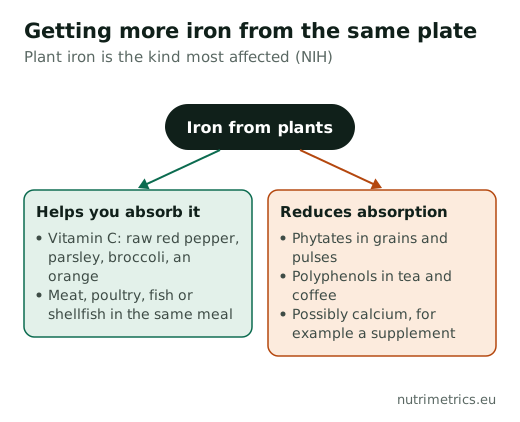
How to absorb more iron from the same plate
According to the NIH:
- Vitamin C helps you absorb iron from plants. Add raw red pepper, parsley, broccoli or an orange to your pulses.
- Meat, poultry, fish and shellfish also increase how much plant iron you absorb from the same meal. Lentils with a little beef, or beans with clams, are good combinations.
- Phytates in grains and pulses and some polyphenols, such as those in tea and coffee, reduce absorption. If you drink tea or coffee, have it away from iron-rich meals.
- Calcium might reduce it too. If you take a calcium supplement, don’t take it with your most iron-rich meal.
Two recipes with the numbers
One comes from our Spanish edition, one from our German edition.
Spanish lentil stew with red pepper (lentejas, 4 servings)
Ingredients: 300 g dried brown lentils, 1 carrot (150 g), 1 onion (100 g), 1 large red pepper (150 g), 2 garlic cloves, 1 bay leaf, 1 tsp paprika, 2 tbsp extra virgin olive oil and salt.
- Gently fry the chopped onion, garlic, carrot and half the pepper.
- Add the paprika, lentils and bay leaf, cover with water and simmer for 35–40 minutes.
- Finely dice the other half of the pepper raw and scatter it over each plate: that way it keeps its vitamin C.
Per serving: about 5.2 mg iron (37% of the NRV) and at least 24 mg vitamin C from the raw pepper alone.
Beef, red pepper and broccoli pan (2 servings)
Ingredients: 300 g lean beef (rump) in strips, 1 red pepper (150 g), 200 g broccoli florets, 1 onion (100 g), 2 tbsp rapeseed oil, a dash of soy sauce and pepper.
- Steam the broccoli for 4 minutes.
- Sear the beef over a very high heat for 2 minutes and take it out.
- Fry the onion and pepper strips for 3 minutes, return the beef and broccoli, add the soy sauce and serve.
Per serving: about 3.4 mg iron (24%), 7.2 mg zinc (72%) and at least 65 mg vitamin C from the broccoli alone.
Who should keep an eye on iron
The NIH lists pregnant women, infants and young children, women with heavy periods, frequent blood donors and people with certain digestive conditions, cancer or heart failure as more likely to run low on iron. If you are in one of these groups and feel tired, have your ferritin checked before you buy anything. We explain how in iron supplements and tiredness.
When food isn’t enough
- If the blood test confirms a deficiency, your GP will tell you what dose to take and for how long. The NHS says 17 mg or less a day from an over-the-counter supplement is unlikely to cause harm. Compare products on our iron page.
- If you have haemochromatosis, don’t take iron supplements.
- Keep iron supplements out of children’s reach.
This guide is part of the series The best supplement is on your plate.
How we calculated the numbers
Values per 100 g come from the USDA’s FoodData Central database (SR Legacy), checked against Spain’s BEDCA database. For black pudding we compared the USDA value (about 6 mg per 100 g) with BEDCA’s figure for Spanish morcilla (18 mg). NutriMetrics calculates the servings, percentages and recipe values. The % NRV uses the 14 mg reference from Regulation 1169/2011, which applies in the UK and the EU. UK daily needs come from the NHS. Real amounts vary with the variety, origin and cooking method.
FAQ
How much iron do I need a day?
The NHS says 8.7 mg a day for men and for women aged 50 and over, and 14.8 mg for women aged 19 to 49, who lose iron through their periods. EFSA sets 11 and 16 mg. The NRV on labels is 14 mg.
Is spinach really that high in iron?
A serving of cooked spinach gives about 5 mg, which is respectable. But the NIH notes that the iron in spinach is poorly absorbed, so it is not the best way to raise your iron.
Can I get enough iron on a vegetarian diet?
Yes, with some planning. The NIH estimates that vegetarians need 1.8 times more iron because they absorb less. Pulses, tofu, seeds and whole grains, always with a source of vitamin C in the same meal.
Is it a good idea to eat liver often?
Liver is very rich in iron, but also in vitamin A. The NHS advises avoiding it during pregnancy, because too much vitamin A can harm the baby.
Should I take an iron supplement just in case?
No. Have your ferritin checked first. If you have haemochromatosis, don't take iron supplements. Always keep iron tablets out of children's reach.
Sources
- NHS — Iron
- USDA FoodData Central — SR Legacy (food composition per 100 g)
- AESAN — Spanish food composition database (BEDCA)
- EFSA (2015) — Scientific opinion on dietary reference values for iron
- NIH Office of Dietary Supplements — Iron, fact sheet for health professionals
- NIH Office of Dietary Supplements — Iron, fact sheet for consumers
- NHS — Vitamins, supplements and nutrition in pregnancy
- Regulation (EU) No 1169/2011, Annex XIII — reference intakes (NRV) and significant amount
- European Commission — Nutrition claims ("source of", "high")