
Key takeaways
- Statins lower CoQ10 in the blood. Whether supplements ease statin muscle pain is disputed: one meta-analysis found less pain, a later one found no benefit.
- The European Atherosclerosis Society says the evidence is lacking, and NICE in England advises not recommending CoQ10 for statin muscle symptoms.
- CoQ10 has no authorised health claim in the UK or the EU. It is generally well tolerated, but it may interact with warfarin.
- If statins make your muscles ache, talk to your GP rather than stopping. Muscle pain has other causes, and treatment can often be adjusted.
The short answer
Statins lower the body’s CoQ10, so it seems logical that topping it up would ease statin-related muscle aches. The trials don’t settle it: the larger, more recent analysis found no benefit, and European and UK guidance doesn’t recommend it. CoQ10 is unlikely to harm you, but it is not a substitute for telling your GP about the pain.
Why the idea makes sense
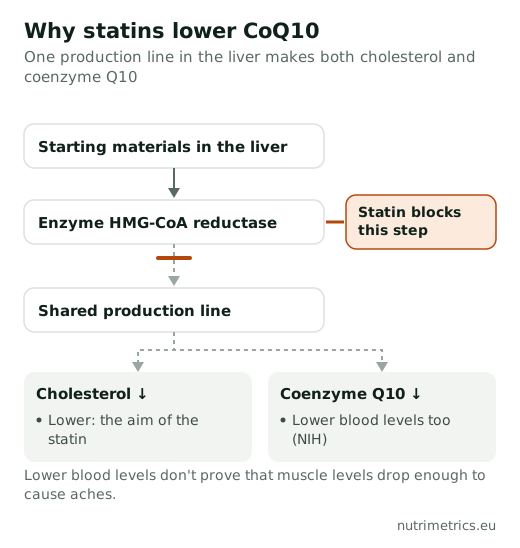
Statins lower cholesterol by blocking an enzyme in the liver. The same production line also makes coenzyme Q10, which cells use to produce energy, and the US NIH confirms that statins lower CoQ10 levels in the blood. The theory is that less CoQ10 in muscle cells causes aches and weakness, and that a supplement could restore it. Lower blood levels, however, don’t prove that muscle levels drop enough to matter.
What the trials show
| Analysis | Trials and people | Result |
|---|---|---|
| Qu et al., J Am Heart Assoc, 2018 | 12 trials, 575 people | Less muscle pain, weakness, cramps and tiredness with CoQ10. Results varied widely between trials; no change in CK, a marker of muscle damage |
| Kennedy et al., Atherosclerosis, 2020 | 7 trials, 321 people with statin muscle pain | No benefit on muscle pain, and people taking CoQ10 were no more likely to keep taking their statin |
The trials were small and short, typically one to three months, and used different doses. When two careful analyses of similar studies reach opposite conclusions, the honest summary is that any benefit is uncertain and likely small.
What guidelines say
- European Atherosclerosis Society (2015): advises against CoQ10 for statin muscle symptoms because the evidence for it is lacking.
- NICE (England): “Do not recommend coenzyme Q10 supplements for the management and prevention of statin-induced muscle symptoms.”
- Health claims (UK and EU): EFSA assessed claims for CoQ10 on energy, blood pressure, cholesterol, physical performance and more in 2010. None was authorised, and the Great Britain register has kept that position.
If you want to try it anyway
Discuss it with your GP or pharmacist first, especially if you take other medicines. If they agree:
- Dose: supplements usually provide 100–200 mg a day. There is no agreed dose for statin symptoms.
- Form: ubiquinone is the standard form; ubiquinol is marketed as “active” and costs more, with no good evidence it works better for this.
- With food: take it with a meal that contains fat.
- Time limit: trials ran for one to three months. If nothing has changed after that, stop.
| Product (our database, Spain and Germany) | Form | CoQ10 a day at label dose |
|---|---|---|
| Vitamaze Coenzym Q10 200 mg | Ubiquinone | 200 mg |
| natural elements Coenzym Q10 | Ubiquinone (fermented) | 200 mg (2 capsules) |
| Solgar Ubiquinol 100 mg | Ubiquinol | 100 mg |
| Vitabay Coenzym Q10 Ubiquinol 200 mg | Ubiquinol | 400 mg (2 capsules) |
Note the Vitabay label: two capsules a day give 400 mg, double the usual range.
Safety
The US NIH reports no serious side effects from CoQ10, but it may interact with warfarin, a blood thinner. Tell your GP or pharmacist before combining it with any prescribed medicine.
What to do about statin muscle pain
Report it to your GP rather than stopping your statin on your own. Muscle pain has many possible causes, and your GP can check for them and adjust your treatment. Statins are prescribed to lower the risk of heart attacks and strokes, and stopping them without advice removes that protection.
Compare all the CoQ10 products we have checked on our CoQ10 page, and see which claims are legal in our guide to approved health claims in the UK and EU.
FAQ
Should I take CoQ10 with a statin?
Not as a routine. Statins lower CoQ10 levels, but trials disagree on whether supplements reduce muscle pain, and European and UK guidance doesn't recommend them for it. If you want to try, discuss it with your GP or pharmacist.
Does CoQ10 help statin muscle pain?
A 2018 meta-analysis of 12 trials found less pain, weakness and cramps, but the results varied a lot between studies. A 2020 meta-analysis of 7 trials found no benefit, and no improvement in how many people kept taking their statin.
Is ubiquinol better than ubiquinone?
Ubiquinol is marketed as the "active" form and costs more. There is no good evidence that it works better for statin muscle symptoms. Both are best taken with a meal that contains fat.
How much CoQ10 do people take?
Supplements usually provide 100–200 mg a day. There is no agreed dose for statin muscle symptoms; trials used a range of doses for one to three months.
Does CoQ10 interact with medicines?
It may interact with warfarin, a blood thinner, according to the US NIH. Tell your GP or pharmacist about any supplement you take with prescribed medicines.
Sources
- DHSC — Great Britain nutrition and health claims (NHC) register
- Qu H et al. Effects of coenzyme Q10 on statin-induced myopathy: an updated meta-analysis of randomized controlled trials. J Am Heart Assoc, 2018
- Kennedy C et al. Effect of coenzyme Q10 on statin-associated myalgia and adherence to statin therapy: a systematic review and meta-analysis. Atherosclerosis, 2020
- Harvard Health — CoQ10 supplements unlikely to benefit statin users (2020)
- NHS Specialist Pharmacy Service — Why people take coenzyme Q10 supplements for statin-induced muscle symptoms (EAS and NICE positions)
- NIH NCCIH — Coenzyme Q10
- EFSA (2010) — Scientific opinion on health claims related to coenzyme Q10
- European Commission — EU Register of nutrition and health claims