
Key takeaways
- In the US GAIT trial (1,583 people), glucosamine and chondroitin, alone or together, did not beat placebo overall. A small group with moderate to severe pain did better on the combination.
- In the European MOVES trial (606 people), the combination matched celecoxib, an anti-inflammatory drug, over six months. The manufacturer of the product funded it.
- In the UK, NICE tells doctors not to offer glucosamine for osteoarthritis and to explain that there is no strong evidence of benefit.
- Guidelines elsewhere disagree: ESCEO recommends pharmaceutical-grade glucosamine sulphate and chondroitin sulphate; OARSI strongly recommends against all formulations.
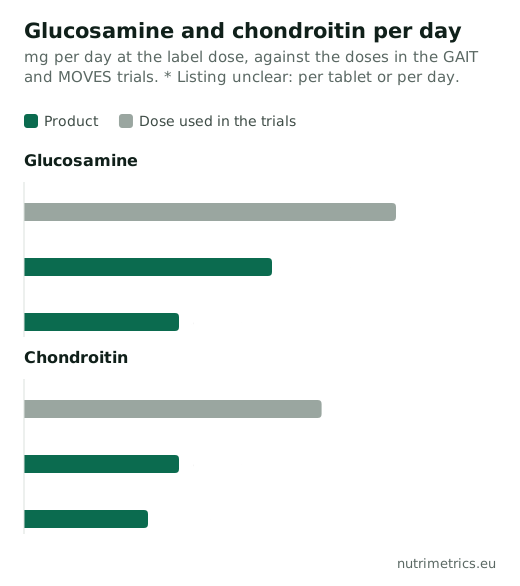
- Trials used about 1,500 mg of glucosamine and 1,200 mg of chondroitin a day. Many combination supplements give much less. There is no authorised joint claim in the UK or the EU.
The short answer
Glucosamine and chondroitin may ease knee osteoarthritis pain for some people, but the evidence is inconsistent and experts disagree. If you want to try them, use trial-level doses of the forms with the best data, give it about six months, and stop if nothing changes. They are not for acute injuries, and swollen or hot joints need a doctor. In the UK, NICE advises GPs not to offer glucosamine, so you are unlikely to get it on the NHS.
The key trials
| Trial | Who | Daily doses | Result |
|---|---|---|---|
| GAIT (USA, 2006) | 1,583 people with knee osteoarthritis, 24 weeks | Glucosamine 1,500 mg, chondroitin sulphate 1,200 mg, alone or together | No significant benefit over placebo overall. In the small group with moderate to severe pain, 79% responded to the combination vs 54% to placebo |
| MOVES (France, Germany, Poland, Spain, 2016) | 606 people with painful knee osteoarthritis, 6 months | Chondroitin sulphate 1,200 mg + glucosamine hydrochloride 1,500 mg | Pain fell by 50% with the combination and 50% with celecoxib: equally effective |
Both results come with caveats. In GAIT, the anti-inflammatory celecoxib only beat placebo by about ten points (70% vs 60% responders), which shows how strong the placebo effect is in joint pain. The moderate-to-severe subgroup was small, so the researchers called the finding preliminary. MOVES compared the supplement with a drug rather than with placebo, and it was funded by Bioibérica, the Barcelona-based company that supplied the product.
What NICE says (UK)
NICE’s 2022 osteoarthritis guideline for England (NG226) is clear: do not offer glucosamine to manage osteoarthritis, and if people ask about it, explain that there is no strong evidence of benefit. The committee noted that the evidence was inconsistent and that the largest benefits came from smaller studies. NICE’s first-line advice is therapeutic exercise, with weight loss where relevant, and topical anti-inflammatory gels for knee pain. The earlier 2014 guideline also advised against chondroitin products.
Why the international guidelines disagree
In 2019, two expert bodies published osteoarthritis guidelines that reach opposite conclusions from much the same studies:
- ESCEO (European Society for Clinical and Economic Aspects of Osteoporosis, Osteoarthritis and Musculoskeletal Diseases) recommends pharmaceutical-grade (crystalline) glucosamine sulphate and chondroitin sulphate as background therapy for knee osteoarthritis, before topical anti-inflammatory gels.
- OARSI (Osteoarthritis Research Society International) strongly recommends against all glucosamine and chondroitin formulations, including pharmaceutical grade.
A 2020 comparison of the two, written by authors from both groups, put the difference down to how each judged the quality and risk of bias of the same evidence. In practice: the best case for these ingredients rests on specific pharmaceutical-grade products, not on any supplement that lists them.
Supplement or medicine?
In Spain, glucosamine sulphate and chondroitin sulphate are also sold as medicines in pharmacies, made to pharmaceutical standards. That is the type of product ESCEO’s recommendation refers to. In the UK, glucosamine is mostly sold as a food supplement, often as glucosamine hydrochloride, and quality varies more. Licensed medicine versions exist, but NICE advises against offering them. A supplement that claims to treat osteoarthritis would be presenting itself as a medicine, which needs an MHRA licence.
Neither the UK nor the EU has an authorised health claim for glucosamine, chondroitin or MSM. EFSA assessed glucosamine’s joint claims in 2009 and 2012 and found no proven cause-and-effect link. That is why many joint supplements add vitamin C, which may claim that it contributes to normal collagen formation for the normal function of cartilage.
Check the dose
| Product (our database) | Glucosamine a day | Chondroitin a day | Compared with trial doses |
|---|---|---|---|
| Vitamaze Glucosamin + Chondroitin + MSM (4 capsules) | 625 mg sulphate | 625 mg | About 40% of the glucosamine and half the chondroitin |
| Nutralie Glucosamina Complex (2 tablets) | 1,000 mg sulphate* | 500 mg* | Closer, but below both |
* The retailer listing doesn’t state clearly whether these amounts are per tablet or per day, and some ingredient amounts are missing. We list it as a partial label.
Neither reaches the doses used in GAIT and MOVES. Taking more tablets to reach them also raises your intake of the other ingredients, so check those too.
Who should be careful
- Shellfish allergy: most glucosamine is made from crustacean shells. Choose a product made by fermentation if you are allergic.
- Warfarin and other blood thinners: glucosamine may increase the risk of bruising or bleeding. Talk to your GP or anticoagulation clinic first.
- Pregnancy and breastfeeding: there is little safety data, so avoid it unless your GP agrees.
How to try it sensibly
- Get a diagnosis first. Knee pain has many causes, and osteoarthritis is only one.
- Choose glucosamine sulphate at about 1,500 mg a day, with or without chondroitin sulphate at 800–1,200 mg, or ask for the pharmacy medicine.
- Note your pain and stiffness at the start.
- Reassess after about six months, and stop if there is no clear difference.
Compare every joint supplement we have checked, with doses side by side, on our joint supplements page. For collagen and hyaluronic acid, read collagen with magnesium or hyaluronic acid.
FAQ
Does glucosamine work for knee osteoarthritis?
The evidence is mixed. Some trials, mostly with pharmaceutical-grade glucosamine sulphate, found less pain; large independent trials such as GAIT found no overall benefit over placebo. Expert guidelines are split.
How much glucosamine and chondroitin should I take?
Trials typically used 1,500 mg of glucosamine and 800–1,200 mg of chondroitin a day. Check the amount per daily dose on the label, as many combination tablets contain less.
How long does glucosamine take to work?
Trials measured results after about six months. If you notice no difference by then, it is unlikely to help you.
Who should not take glucosamine?
People with a shellfish allergy (unless the product is from a non-shellfish source), people taking warfarin or other blood thinners without medical advice, and pregnant or breastfeeding women.
Is MSM worth taking for joints?
MSM is often added to joint blends, but its evidence is limited and it has no authorised health claim in the UK or the EU.
Sources
- NICE NG226 — Osteoarthritis in over 16s: diagnosis and management (recommendations 1.4.6–1.4.7)
- DHSC — Great Britain nutrition and health claims (NHC) register
- NIH — Efficacy of glucosamine, chondroitin sulfate may depend on level of osteoarthritis pain (GAIT, Clegg et al., NEJM, 2006)
- Hochberg MC et al. Combined chondroitin sulfate and glucosamine for painful knee osteoarthritis: a multicentre, randomised, double-blind, non-inferiority trial versus celecoxib (MOVES). Ann Rheum Dis, 2016
- Arden NK et al. Non-surgical management of knee osteoarthritis: comparison of ESCEO and OARSI 2019 guidelines. Nat Rev Rheumatol, 2020
- EFSA (2009) — Glucosamine and maintenance of joints
- EFSA (2012) — Glucosamine and maintenance of normal joint cartilage
- Merck Manual (consumer version) — Glucosamine