
Key takeaways
- The UK's Committee on Toxicity concluded in 2024 that there is reasonable evidence of a link between turmeric supplements and liver toxicity, including rare cases at doses below the acceptable daily intake.
- France recorded over 100 suspected side effects, 15 of them hepatitis, and Italy about 20 hepatitis cases. Italy has required a liver warning on turmeric supplements since 2022.
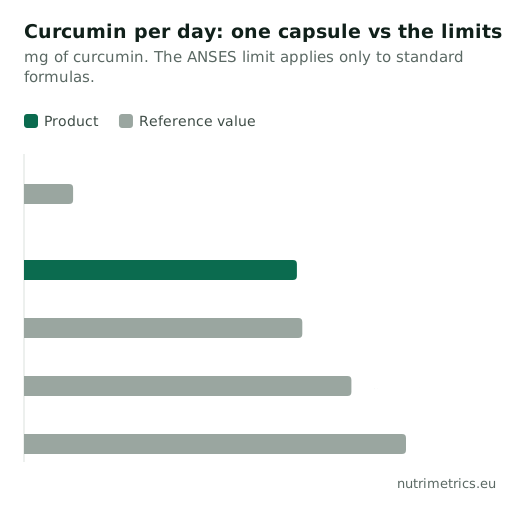
- EFSA's acceptable daily intake for curcumin is 3 mg per kg of body weight: 180 mg at 60 kg. France's ANSES advises no more than 153 mg a day from supplements.
- Piperine and "high-absorption" formulas change the picture: German and UK risk assessors say a simple mg-per-day limit may not reflect their safety.
- For knee osteoarthritis, a 2022 analysis of 15 trials found modest pain relief, but the studies were of low quality. No health claim is authorised in the UK or the EU.
The short answer
Turmeric in your cooking is fine. Concentrated turmeric and curcumin supplements have been linked to rare cases of liver injury across Europe and beyond, and the risk seems higher with formulas built to boost absorption. If you take one, stay within the daily limits regulators use, avoid it if you have liver or gallbladder problems or take blood thinners, and stop at the first sign of trouble.
What happened
| When | Where | What |
|---|---|---|
| 2018–2019 | Italy | About 20 cases of hepatitis linked to turmeric supplements in Tuscany and Lombardy. Contamination and added substances were ruled out. |
| 2019 | Belgium | A turmeric product linked to the Italian cases was recalled. |
| 2020 | Germany | The BfR found first signs of liver-damaging effects, particularly for preparations with enhanced absorption. |
| 2022 | France | ANSES reported over 100 suspected side effects, including 15 cases of hepatitis, and set a daily limit for supplements. |
| 2022 | Italy | A decree required a liver warning on labels from 31 December 2022 and banned health claims for turmeric. |
| 2023 | Australia | The regulator reported 18 cases of liver problems, two severe and one fatal. |
| 2024 | United Kingdom | The Committee on Toxicity (COT), which advises the Food Standards Agency, concluded that there is reasonable evidence of a link between turmeric and liver toxicity, that rare cases occurred even below the acceptable daily intake, and that liver effects may be idiosyncratic: rare and unpredictable. In an FSA survey of 15 supplements, 2 would exceed the acceptable daily intake if taken as the label says. |
Cases are rare compared with the number of people who take turmeric. But because nobody can predict who will react, regulators focus on keeping doses moderate and warning the people most at risk.
In the UK
- Turmeric supplements are legal and widely sold, but the COT’s 2024 statement is the most detailed official UK assessment: it found reasonable evidence of a link with liver injury and warned that “better absorbed” formulas make simple dose limits unreliable.
- The FSA’s novel foods team considers food supplements made from turmeric oleoresin extract or pure curcumin powder to be novel foods, because they were not significantly consumed before May 1997. On that view such extracts would need authorisation before sale in Great Britain; plain turmeric powder would not. Products are on sale regardless, which is one more reason to read the label carefully.
- There is no UK maximum dose; the EFSA acceptable daily intake below is the figure the COT works with.
The daily limits
| Limit | Amount | Notes |
|---|---|---|
| EFSA acceptable daily intake (curcumin) | 3 mg per kg body weight | 180 mg at 60 kg, 210 mg at 70 kg, from all sources |
| ANSES maximum from supplements (France) | 153 mg a day for a 60 kg adult | Leaves room for food; standard formulas only |
| Intake from food, high consumers (France) | About 27 mg a day | People who eat a lot of turmeric-rich food |
Many supplements give more than 153 mg of curcumin a day. Check both the extract amount and the percentage of curcuminoids; not every label makes this clear.
How to compare turmeric supplements by milligrams
You can, but only by one number: milligrams of curcuminoids per daily dose. The weight of “turmeric” on the front says very little. In the US Dietary Supplement Ingredient Database programme (NIH and USDA), products labelled 500 mg of turmeric a day contained anything from 16 to 554 mg of curcuminoids when tested. Products that stated their curcuminoid content were mostly close to the label.
How to work it out:
- Find the extract per capsule and its % curcuminoids (often 95%), and multiply them: 500 mg × 95% = 475 mg.
- Multiply by the capsules per day on the label.
- If the label only gives turmeric root powder, count on a few per cent: curcuminoids make up about 3% of the dried root.
- If it gives a ratio (“10:1, equivalent to 10,000 mg”), you can’t work it out: the ratio says how much root went in, not how much curcumin came out.
- Compare the result with 153 mg a day (ANSES, for a 60 kg adult) or 3 mg per kg of your body weight (EFSA, from all sources).
| Example label | Curcuminoids per day | Compared with 153 mg (ANSES, 60 kg) |
|---|---|---|
| 3 × 500 mg turmeric root powder | About 45 mg (about 3%) | Well below |
| 1 × 500 mg extract, 95% curcuminoids | 475 mg | About three times as much |
| 2 × 250 mg extract, 95% curcuminoids | 475 mg | The same dose in smaller capsules |
| 1 × 1,000 mg 10:1 extract (“equivalent to 10,000 mg”) | Not stated | Can’t tell from the label |
| 1 × 500 mg phytosome, 20% curcuminoids | 100 mg, absorbed better | Not comparable: the 153 mg figure is for standard formulas |
These are example labels to show the arithmetic, not products we tested. Only compare like with like: a milligram of a standard extract and a milligram of an enhanced-absorption formula do not mean the same exposure, as the next section explains.
Why “better absorbed” is not automatically better
Curcumin on its own is poorly absorbed, so manufacturers add piperine (black pepper extract) or use micelles, phytosomes, nanoparticles or cyclodextrins to raise blood levels. That changes the safety picture:
- ANSES says these formulas can raise curcumin’s effects even when the dose stays under the limit, that labels rarely say which type you are buying, and that its 153 mg figure applies only to standard formulas.
- Germany’s BfR says such products should not be assumed to be as safe as ordinary curcumin.
- The UK Committee on Toxicity warns that a standard mg-per-day limit may not reflect their safety.
- The US NIH states that highly bioavailable curcumin formulas may harm the liver.
An example from our database: Sunday Natural Kurkuma-Extrakt + Piperin gives 150 mg of curcuminoids and 5.3 mg of piperine per capsule. On paper that is just under ANSES’s 153 mg. But because it contains piperine, ANSES’s figure doesn’t really apply, and the actual exposure is higher than the milligrams suggest.
Who should avoid turmeric supplements
- People with liver disease or bile duct or gallbladder problems (ANSES and Italy’s label warning).
- People taking anticoagulants, cancer medicines or immunosuppressants, unless their GP or specialist agrees (ANSES).
- Pregnant women: the US NIH says turmeric supplements may be unsafe in pregnancy.
Warning signs to stop and see a doctor (GP, or NHS 111 if it is urgent): unusual tiredness, nausea, loss of appetite, dark urine, or yellowing of the skin or eyes.
Does it work?
For knee osteoarthritis, a 2022 meta-analysis of 15 randomised trials with 1,670 patients found that curcuminoids reduced pain and stiffness and improved function compared with placebo, and seemed no worse than anti-inflammatory painkillers. The authors called the studies low quality and varied, and urged caution. The US NIH describes the early evidence as positive but not definitive.
For most other uses, there isn’t enough evidence to say. No health claim for turmeric or curcumin is authorised in the UK or the EU (botanical claims are on hold on both registers), so labels promising joint, liver or digestive benefits are not using approved wording.
Compare the turmeric products we have checked on our turmeric page. If joint pain is your reason for buying, see also glucosamine and chondroitin: do they work?.
FAQ
Is turmeric bad for your liver?
Turmeric as a spice in food is not the concern. Rare cases of liver injury have been linked to concentrated turmeric and curcumin supplements, especially formulas designed to raise absorption. Most people who take them have no problems, but the risk can't be predicted.
How much curcumin is safe a day?
EFSA's acceptable daily intake is 3 mg per kg of body weight, about 180 mg at 60 kg and 210 mg at 70 kg, from all sources. France's ANSES advises no more than 153 mg a day from supplements for a 60 kg adult, and that figure applies only to standard formulas.
Can you compare turmeric supplements by milligrams?
Only by milligrams of curcuminoids per daily dose, and only between standard formulas. The weight of turmeric on the label says little: in a US government analysis, products labelled 500 mg of turmeric a day contained 16 to 554 mg of curcuminoids. Multiply the extract per capsule by its % curcuminoids and by the capsules per day, then compare the result with 153 mg a day (ANSES, for a 60 kg adult).
Is turmeric with black pepper (piperine) safer or more dangerous?
Piperine makes the body absorb much more curcumin, so the same milligrams have a bigger effect. Germany's BfR says such products should not be assumed to be as safe as ordinary curcumin, and the US NIH warns that highly bioavailable formulas may harm the liver.
Who should not take turmeric supplements?
People with liver or bile duct problems, people taking anticoagulants, cancer medicines or immunosuppressants (unless their doctor agrees), and pregnant women. Stop and see your GP if you notice tiredness, nausea, dark urine or yellowing skin or eyes.
Does turmeric work for joint pain?
A 2022 meta-analysis of 15 trials in knee osteoarthritis found modest reductions in pain and stiffness compared with placebo, but the authors called the evidence low quality. The US NIH describes the early evidence as positive but not definitive.
Sources
- Andrews K et al. Label claims vs measured curcuminoid content in turmeric supplements (NIH/USDA Dietary Supplement Ingredient Database). Curr Dev Nutr, 2021 (conference abstract)
- Skiba MB et al. Curcuminoid content and safety-related markers of quality of turmeric dietary supplements sold in the United States. Mol Nutr Food Res, 2018
- COT (2024) — Statement on the potential risk to human health of turmeric and curcumin supplements
- COT — Turmeric and curcumin supplements: lay summary
- DHSC — Great Britain nutrition and health claims (NHC) register
- ANSES — Adverse effects linked to food supplements containing turmeric (2022, French)
- NutraIngredients — How turmeric supplements brought bioavailability and idiosyncrasy into regulatory focus (2026)
- FoodNavigator — Italy prohibits all health claims linked to turmeric, issues warning for labels (2022)
- EFSA (2010) — Scientific opinion on the re-evaluation of curcumin (E 100) as a food additive
- NIH NCCIH — Turmeric (updated April 2025)
- Efficacy and safety of curcuminoids alone in alleviating pain and dysfunction for knee osteoarthritis: a systematic review and meta-analysis of randomized controlled trials. BMC Complement Med Ther, 2022