
Key takeaways
- In the UK, melatonin is a prescription-only medicine. The MHRA says any product containing melatonin must be regulated as a medicine, so melatonin gummies or tablets sold as supplements in the UK are illegal.
- On prescription it is licensed for short-term insomnia and jet lag in adults, and for insomnia in 6- to 17-year-olds with ADHD.
- EU law allows two claims: melatonin reduces the time it takes to fall asleep (1 mg shortly before bed) and alleviates jet lag (0.5 mg).
- In Spain, above 2 mg a day melatonin counts as a medicine, which is why so many Spanish products contain 1.9 mg. In Germany its status as a supplement is legally disputed.
- Not for children, pregnancy or breastfeeding without medical advice; it can interact with sedatives and blood thinners.
The short answer
Melatonin helps you fall asleep sooner; it does not make you sleep longer or deeper. In the UK you can only get it on prescription: it is a licensed medicine, not a supplement. In much of the EU it is sold over the counter, and the only authorised sleep claim there is based on 1 mg shortly before bedtime. If you have slept badly for weeks, melatonin is not the underlying fix: talk to your GP.
Melatonin in the UK
- Prescription-only. The MHRA, the UK medicines regulator, says any product that contains melatonin must be regulated as a medicine and needs a marketing authorisation (a licence) to be sold or supplied in the UK.
- What it is licensed for: the short-term treatment of insomnia and jet lag in adults, and insomnia in children and adolescents aged 6 to 17 with ADHD, when other sleep measures have not been enough.
- Products sold as supplements are illegal. Which? found melatonin listed for sale on UK online marketplaces in breach of the rules. In August 2025 the MHRA told parents to stop using a brand of children’s “magnesium” gummies after its lab found undeclared melatonin in them.
- Claims: the two melatonin claims below are still on the Great Britain claims register, copied from the EU list, but they cannot be used on any product sold in the UK, because a melatonin product is a medicine here.
- Buying from abroad: an EU product that is legal in Spain is still a medicine in the UK. Ask your GP or pharmacist before ordering one; they can also check interactions with what you already take.
If you live in the UK, the rest of this guide explains what the evidence and EU rules say, which is useful context for a conversation with your GP or for travelling.
What EU law allows
| Authorised claim | Condition |
|---|---|
| Melatonin contributes to the reduction of time taken to fall asleep | 1 mg taken close to bedtime |
| Melatonin contributes to the alleviation of subjective feelings of jet lag | At least 0.5 mg close to bedtime on the first day of travel and the first few days after arrival |
Not authorised: deeper sleep, fewer awakenings, less anxiety or “resetting your body clock” in general. See our table of approved health claims in the UK and EU.
Legal status by country
| Country | Status | What the rule says | Source |
|---|---|---|---|
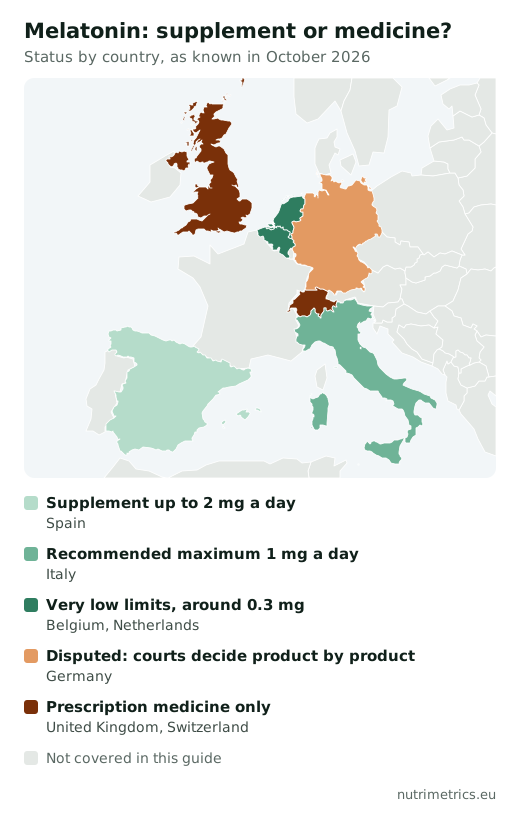
| Spain | Supplementbelow 2 mg/day | Food supplement below 2 mg a day; from 2 mg it counts as a medicine (AEMPS criterion). That is why so many Spanish products contain 1.9–1.99 mg. | Basque Government — Use of melatonin in food supplements (AESAN/AEMPS criterion) |
| France | Supplementbelow 2 mg/day | Food supplements may provide less than 2 mg a day; higher doses are medicines. ANSES advises pregnant and breastfeeding women, children, teenagers and people with some conditions not to take melatonin supplements. | Ordre national des pharmaciens — ANSES advice on melatonin supplements (French) |
| Italy | Supplementmax. 1 mg/day | Food supplements may provide at most 1 mg a day (Ministry of Health, June 2013; previously 5 mg). Above that, melatonin is treated as a medicine. | Altroconsumo — Melatonina (Italian) NutraIngredients — Italy cuts maximum melatonin levels from 5 mg to 1 mg (2013) |
| Portugal | Supplementmax. 1 mg/day | The food authority DGAV accepts supplement notifications only up to 1 mg a day, and not for children (2016 opinion on the boundary between medicines and supplements). | DGAV — Opinion on melatonin in food supplements, July 2016 (Portuguese) |
| Belgium | Supplementbelow 0.3 mg | The medicines agency (FAGG/AFMPS) treats oral products with 0.3 mg or more as medicines, and products absorbed in the mouth (sprays, melts) from 0.2 mg. That is why Belgian supplements contain about 0.29 mg. | Habraken H et al. Melatonine bij kinderen met slapeloosheid? Tijdschrift voor Jeugdgezondheidszorg, 2022 (Dutch) Luxembourg Ministry of Health — Answer to parliamentary question 3172 on melatonin, 2017 (French) |
| Netherlands | Supplementbelow 0.3 mg/day | A food supplement only below 0.3 mg a day and without any health claim; from 0.3 mg it is a medicine that needs a marketing authorisation (IGJ and NVWA). | Dutch government — Answers to parliamentary questions on melatonin, 2019–2020 no. 297 (Dutch) IGJ and NVWA — Letter on stepped-up supervision of melatonin products (Dutch) |
| Germany | Disputedno legal limit | No legal maximum. The federal institutes have regarded melatonin as a medicine since 1996, but the federal states decide and courts have ruled both ways; supplements with 0.5–1.5 mg a day are widely sold. Melatonin medicines are prescription-only. | BfR — Melatonin-containing food supplements: possible health risks (Opinion 038/2024, German) Verbraucherzentrale NRW — Melatonin zum Einschlafen (German) PTA heute — Wie viel Melatonin in NEM ist erlaubt? (2022, German) |
| Denmark | Medicine only | Melatonin products are medicines and need a prescription. A product sold as a supplement elsewhere is generally treated as a medicine when it is sent to Denmark, and medicines may not be received from outside the EU/EEA. | Danish Medicines Agency — Are you considering buying melatonin online? |
| Sweden | Medicine only | A medicine (prescription and some non-prescription medicines). Selling it as a food supplement is illegal; the Medical Products Agency has banned the sale of several such products. | Läkemedelsverket — Risk that melatonin is used too lightly (press release, 24 March 2025, Swedish) |
| Ireland | Medicine only | A prescription-only medicine that is not authorised in food. The food safety authority FSAI recalls supplements that contain it (most recently in May 2026). | FSAI — Medicinal product (melatonin) not permitted in food: Jelly Pills supplements (alert 2026.29, 29 May 2026) |
| United Kingdom | Medicine only | A prescription-only medicine: the MHRA says any product containing melatonin is a medicine, so melatonin supplements are illegal in the UK. | MHRA — Parents advised to stop using a brand of kids' magnesium gummies containing undeclared melatonin (18 August 2025) |
| Switzerland | Medicine only | Only as a prescription medicine; selling it as a food or food supplement is prohibited. Swissmedic warns against importing it privately (warning of 27 November 2023). | Swissmedic — Warning about imports of melatonin and DHEA by private individuals (27 November 2023) |
| EU level | EU-wide | No EU-wide maximum: each country sets its own rule. Two authorised claims: falling asleep faster (1 mg shortly before bedtime) and jet lag (at least 0.5 mg). A product lawful in one EU country can often be sold in another (mutual recognition). | European Commission — EU Register of nutrition and health claims |
National rules change. Check the date and the source before you rely on a row.
Under EU mutual recognition, a product legal in one EU country can often be sold in another, which is why higher-dose products appear online across borders. That principle does not apply to Great Britain. Our guide to supplement maximum levels compares more countries and nutrients.
Why more is not better
The authorised claim is based on 1 mg. No claim exists for higher doses, so a 1.9 mg tablet gives almost twice the amount behind the recognised effect, and imported 5 or 10 mg products far more. If 1 mg does not help you fall asleep sooner, a higher dose is not the logical next step — a conversation with a doctor is.
Who should avoid it
- Children and teenagers, unless prescribed. In the UK, melatonin for children is a specialist prescription. German paediatricians want melatonin gummies banned, and the BfR advises against giving melatonin supplements to children on parents’ own initiative.
- Pregnant and breastfeeding women.
- People taking sedatives, blood thinners or other medicines that affect sleep: check with a doctor or pharmacist first.
Commonly reported effects include morning drowsiness, headache and dizziness. Don’t drive if you feel drowsy the next day.
How to use it sensibly
In the UK, follow your prescription. Where melatonin is sold as a supplement:
- Start with the authorised dose: 1 mg shortly before bed.
- Use it for something specific: falling asleep during a bad patch, a time-zone change or jet lag.
- Set an end date. If you still need it after a few weeks, a supplement is not the answer. Chronic insomnia has treatments with far stronger evidence, such as cognitive behavioural therapy for insomnia.
- Read the label: many products add herbs (passionflower, lemon balm, valerian) that have no authorised claims.
For a hormone-free option, our guide to magnesium for sleep explains what the trials show, and our goal finder compares the evidence for different sleep options.
FAQ
Can I buy melatonin over the counter in the UK?
No. Melatonin is a prescription-only medicine in the UK. The MHRA treats any product that contains it as a medicine that needs a licence, so melatonin sold as a food supplement in UK shops or on marketplaces is being sold illegally. A GP or specialist can prescribe it when it is appropriate.
What is melatonin prescribed for in the UK?
According to the MHRA, it is authorised for the short-term treatment of insomnia and jet lag in adults, and for insomnia in children and adolescents aged 6 to 17 with ADHD when other sleep measures have not been enough.
How much melatonin works to fall asleep?
The EU-authorised claim is based on 1 mg taken shortly before bedtime, to reduce the time it takes to fall asleep. No claim is authorised for higher doses. In the UK the dose is set by your prescriber.
Is melatonin legal in Europe?
It depends on the country. Spain sells it as a supplement up to 2 mg a day; Italy recommends a maximum of 1 mg; Belgium and the Netherlands allow only very low amounts; it is prescription-only in the UK and Switzerland; in Germany its status as a supplement is disputed.
Can children take melatonin?
Not without medical advice. In 2025 the MHRA told parents in the UK to stop using a brand of children's magnesium gummies after tests found undeclared melatonin. German paediatricians and the BfR also advise against giving melatonin supplements to children on parents' own initiative.
When should I take melatonin for jet lag?
In the EU, the authorised claim is based on at least 0.5 mg shortly before bedtime on the first day of travel and on the first few days after arrival. In the UK, follow the prescription.
Can you buy melatonin in Belgium or the Netherlands?
Only at very low doses. Both countries treat oral products with 0.3 mg or more a day as medicines, so supplements there contain about 0.1–0.29 mg; in Belgium, sprays and melts count as medicines from 0.2 mg. In the Netherlands these products may not carry any health claim. Higher doses need a prescription.
Is melatonin legal in Switzerland?
Only as a prescription medicine. Swissmedic says melatonin may not be sold as a food or food supplement in Switzerland, and it warns against importing it privately.
Sources
- MHRA (18 August 2025) — Parents advised to stop using a brand of kids' magnesium gummies containing undeclared melatonin, a prescription-only medicine
- Which? — Sleep drug melatonin illegally listed for sale on online marketplaces
- DHSC — Great Britain nutrition and health claims (NHC) register
- European Commission — EU Register of nutrition and health claims (melatonin)
- Commission Regulation (EU) No 432/2012 — list of permitted health claims
- Basque Government — Use of melatonin in food supplements (AESAN/AEMPS 2 mg criterion, 2013, Spanish)
- PTA heute — How much melatonin is allowed in supplements? (Germany, 2022, German)
- Apotheken Umschau — Paediatricians warn against melatonin gummies (updated August 2026, German)
- NutraIngredients — Italy slashes maximum melatonin levels from 5 mg to 1 mg (2013)